gvSIG application to urban planning (workshop Video)

It is now available the video of workshop “gvSIG application to urban planning”. Without any doubt, GIS is an essential tool in such a sector; but quite often its use in not so common, mainly due to lack of knowledge in these technologies and to proprietary licenses high cost. This workshop aims to reduce these constraints: work with open source software, without any license cost, and spread knowledge of gvSIG use for urban-related tasks.

Some practical exercises are carried out to illustrate a series of analysis related to urban planning project in a neighbourhood of the city of Valencia, providing an overview of the main features of gvSIG that are needed for such a study, ranging from editing and processing thematic maps till specific geoprocessing.

You can find more information about the workshop content and download of used data from:

https://blog.gvsig.org/2015/11/23/11gvsig-gvsig-applied-to-town-planning-workshop/

The manual (in Spanish) to follow the workshop can be found in:

Libro: Taller gvSIG aplicado a urbanismo

Below, you can watch the workshop video:

We hope that these activities could be useful to new groups to discover the full potentiality of gvSIG!

Libro: Taller gvSIG aplicado a urbanismo

Posted in english, gvSIG development, opinion | 1 Comment

Taller de gvSIG aplicado a urbanismo (Vídeos)

Ya está disponible el vídeo del taller de gvSIG aplicado a urbanismo. Sin duda alguna, el ámbito del urbanismo es uno de los principales donde potencialmente el SIG es una herramienta fundamental. Sin embargo nos encontramos con que su uso no es precisamente habitual, en gran parte debido al desconocimiento de estas tecnologías y al alto coste de las licencias privativas. Este taller pretende minimizar ambas causas: trabajamos con software libre, sin coste de licencia, e intentamos introducir a nuevos usuarios en el manejo de gvSIG para tareas relacionadas con el urbanismo.

Mediante ejercicios prácticos se llevan a cabo una serie de análisis relacionados con un proyecto de urbanismo en un barrio de la ciudad de Valencia, haciendo un recorrido por las principales funcionalidades de gvSIG necesarias para este tipo de estudios, que incluyen desde la edición y la elaboración de mapas temáticos a determinados geoprocesos.

Podéis encontrar más información sobre el contenido del taller y descarga de los datos utilizados durante el mismo en:

https://blog.gvsig.org/2015/11/12/11gvsig-taller-gvsig-aplicado-al-urbanismo/

El manual para seguir el taller está en:

https://blog.gvsig.org/2015/11/20/libro-taller-gvsig-aplicado-a-urbanismo/

Os dejamos con el vídeo del taller:

¡Esperamos que este tipo de actividades sean útiles a nuevos colectivos y descubran todo el potencial de gvSIG!

Posted in events, gvSIG Desktop, spanish, training | Tagged , | 3 Comments

gvSIG Roads: Gestión integral de carreteras con software libre

Logo_gvsigRoads

Con este post os queremos presentar gvSIG Roads, una solución que se suma al catálogo de productos de la Asociación gvSIG para la gestión integral de infraestructuras viarias basada en una suite de aplicaciones libres entre las que destacan gvSIG Desktop y gvNIX (¡¡también productos libres de la factoría gvSIG!!).

Esta solución tiene su origen en un proyecto para Diputación de Valencia, que confió en la Asociación gvSIG para llevar a cabo la que ahora se presenta como la solución libre para gestión de carreteras.

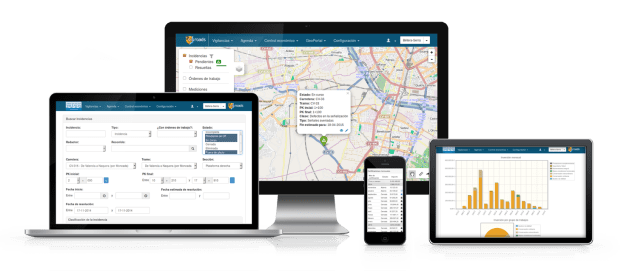
gvSIG Roads es mucho más que un SIG, es una plataforma integral de gestión de carreteras que está compuesta por una potente aplicación de gestión web, un SIG de escritorio para la edición y mantenimiento de cartografía, bases de datos espaciales, servidor de mapas, geoportal y software móvil para tareas de trabajo de campo.

Es una solución que cubre todas las necesidades de gestión de la conservación de carreteras como partes y recorridos de vigilancia, incidencias, tareas y ordenes de trabajo, mediciones y certificaciones. Permite mantener una homogeneidad de procedimientos de trabajo, documentación, coordinación con las empresas contratistas y acceso a la información.

Por supuesto gvSIG Roads está diseñado para ser fácilmente extensible, permitiendo una mejora continua de la aplicación, ampliando sus capacidades en ámbitos como el inventario, seguridad vial, expropiaciones,….así como su adaptación a medida de las necesidades de cada entidad.

Os dejamos con un vídeo de las pasadas Jornadas Internacionales de gvSIG donde se explica en detalle el potencial de gvSIG Roads:

Si estás interesado en implantar gvSIG Roads en tú organización, contacta con nosotros: info@gvsig.com. Además de contar con los mejores expertos en geomática libre estarás ayudando al mantenimiento y desarrollo de la tecnología gvSIG.

Posted in Projects, spanish | Tagged , | 6 Comments

Where are the sources in gvSIG Desktop?

Hi everyone,
Here it comes a new small article about development with gvSIG Desktop.

In the last months, I´ve been asked many times about where are the gvSIG´s sources.
The quick answer would be::

http://devel.gvsig.org/svn/gvsig-desktop/

But in general, this is not enough.

The general advise which I give always is that do not recompile gvSIG Desktop. There is not need for creating your own plugins.

You should work against some binaries of gvSIG and develop your plugins without compiling all gvSIG, a really hard task. For your information, compile all gvSIG and create a distribution takes 10 hours more or less, without any problem. The process involves compile the gvSIG core along 60 more projects delivered over 40 different repositories, to finish creating a distribution with the core plus all the plugins of the distribution.

This makes that in addition to know about your problem, you must have the enough knowledge to compile and solve all the problems which can appear when setting up all the plugins of the distribution.

And not only that… if you modify the sources, compile them and share over your users, and not reversing these changes to the project, you will “anchor” those users to that gvSIG version. If they try to update it to access to fixings or improvements in previous versions, they will lose your changes. You will force them to choose between your customization or the improvements of the new gvSIG versions. And to each version, you will have to carry your changes. Every time that a new version had created, you will have to take your changes and put them again in your fork.

There are may of them that think ok,….why not?

In my personal opinion, in the medium-term this is not usually good for the ones who makes this practice or for the users. Sooner or later, the users will be disappointed with this software, requiring efforts to keep it updated. Efforts which are going over the customization, due to you will be loading your development with the maintenance of the one gvSIG distribution and not the concrete solution needed for your users.

To avoid this, in gvSIG we have being made some effort for modulating it, and introducing the “extension points” needed for not having to modify “core” and you will be able to do whatever you need from your plugins. The idea would be to have a standard distribution of gvSIG Desktop installed, and over it deploy your plugins with the intention of creating your own distribution from the standard one and your plugins (there are already some tools for creating customised distributions of gvSIG, you can read about it in Create your new plugin.

And if there is something that you don´t know to do from your plugin and believe that you need to do it changing the source code of gvSIG, you should ask to the development mailing lists. Sometimes, it is only a focus problem or we can add a new extension point suitable for doing what you need from your plugins. Or sometimes what you want to do can be helpful for other users and we can integrate it in the gvSIG code.

Sometimes I´ve been told that only want to see the gvSIG code. Well, even for that, there is no need to download the sources. Usually the SDI that you use can download the sources automatically for viewing, because each jar created of gvSIG creates another one with its sources, being available in the maven repository of the project.

In spite of this, I understand that at any point you want to know where are the sources…because it gives some security.The gvSIG sources are always available for everyone.. You can look for them in the link of the beginning and there is all “core” of gvSIG. You can download the trunk sources, but it is not an advisable option. These have the changes which we are we working with and sometimes are not stables.
So, then….

Which sources should be working with?

With each distribution generated by gvSIG, being a final version, RC, tested or of development. a tag is created in the SVN with the version number where the sources can be found. However, these numbers don´t follow the same criteria that the distribution. The version and the build number are orientated to the product. They can be changed arbitrarily to fit non technical criteria. From the development point of view, we use automatic version numbers, always incrementally and unique, and they can not be the same than in the distribution.

So… How do we know the “development” version of one gvSIG distribution

Starting for the easy one… How do I know the development version of the gvSIG core for a concrete distribution?

Well, if we have one gvSIG distribution, we can look in the “lib” folder at the root installation. There, we look the file:

  org.gvsig.andami-*.jar

We find, for instance:

  • gvSIG 2.2.0-2313 ===> org.gvsig.andami-2.0.100.jar
  • gvSIG 2.1.0-2269 ===> org.gvsig.andami-2.0.84.jar

This means that the project version org.gvsig.desktop, which is the gvSIG core, for the 2.2.0-2313 is the 2.0.100.

Once we know exactly which is the gvSIG core version, we can go to the SVN of the project (the URL of the beginning) and in the tags folder, we will find:

http://devel.gvsig.org/svn/gvsig-desktop/tags/org.gvsig.desktop-2.0.100

…which will have the sources of that version of the gvSIG core.

But, those are only the core sources. And if I want to download the sources of one plugin which is not in the core?

Well, that has a dark part, by one side and another one easier. Where the SVN of that plugin is and which version is the one used for the distribution.

Let´s start for the easy one with an example. Which is the development version of the data provider for the PostgreSQL?

We go as for the core of the gvSIG installation. In this case to the lib folder inside of the plugin:

  gvSIG/extensiones/org.gvsig.postgresql.app.mainplugin/lib

There we look the jar:

  org.gvsig.postgresql.app.mainplugin-*.jar

In general, the jar will have the same name that the one in the plugin folder followed by the version number. So, this version number will be the one that we will have to look for in the tag folder of the SVN od the project. In the case of postgreSQL would be something like:

http://devel.gvsig.org/svn/gvsig-postgresql/tags/org.gvsig.postgresql-2.0.30/

For gvSIG Desktop 2.2.0-2313 .

The most complicated will be to guess in which “lives” that plugin. There is not list with that information. The only thing that I can advise you is that you go to the project list of the gvSIG redmine, and try to locate the project of the redmine correspondent with the plugin, from which you want the sources. For example, for PostgreSQL would be:

https://redmine.gvsig.net/redmine/projects/gvsig-postgresql

And it should be there the URL to the SVN of the project.

If you are not able to find it, as always, you can ask development mailing lists

I hope that this post had been useful.
Regards,
Joaquín

Posted in development, english, gvSIG Desktop | 2 Comments

gvSIG Online: IDE de la Unión Internacional para la Conservación de la Naturaleza

La Asociación gvSIG, más allá de ser conocida por el desarrollo de diversas tecnologías en software libre como gvSIG Desktop o gvNIX, se ha convertido en estos últimos años en un referente internacional en la prestación de servicios de geomática libre y, especialmente, en lo que se refiere a la puesta en marcha de Infraestructuras de Datos Espaciales (IDE) con software libre.

Enmarcados en las IDE, en este post os queremos hablar de uno de los últimos proyectos que hemos desarrollado: la implantación de una Infraestructura de Datos Espaciales en la Unión Internacional para la Conservación de la Naturaleza, organización conocida por sus siglas UICN (o IUCN en su acrónimo en inglés). Este proyecto ha sido desarrollado con el nuevo producto de la Asociación gvSIG, gvSIG Online, del que hablaremos más detalladamente en futuros post.

UICN es la primera organización medioambiental a nivel internacional. Constituye la red global más amplia de profesionales relacionados con el ámbito de la conservación del medio ambiente. Unas pocas cifras nos permiten intuir la importancia de esta institución: contempla más de 1.200 organizaciones miembro de 160 países, incluyendo más de 200 organizaciones gubernamentales y más de 800 no gubernamentales. Cuenta con 11.000 científicos y expertos voluntarios, 1.100 profesionales y 45 oficinas repartidas alrededor del mundo.

En la práctica esto se traduce en miles de proyectos de campo y actividades alrededor del mundo…de las cuales un amplio porcentaje tienen una componente geográfica y producen información georreferenciada. Una información muy valiosa y que, hasta este proyecto, era casi imposible reutilizar al no existir un mecanismo que permitiera no sólo tenerla localizada,sino también compartirla, combinarla e interoperar con ella para poder aprovechar todo el potencial de esta base de datos de conocimiento de carácter espacial.

El proyecto de la IDE se planteó como un proyecto que comenzará por resolver una problemática concreta y que rapidamente pudiera ser escalable a toda la organización. Así, dentro de la oficina de UICN de Mesoamérica, se planteó su aplicación a los proyectos de restauración de paisajes rurales como un primer punto de inicio de la IDE.

Los proyectos de restauración de paisajes rurales consistentes en un conjunto de técnicas y actividades para fortalecer la capacidad de recuperación de los paisajes bajo la metodología conocida como ROAM (Restoration Opportunities Assessment Methodology), son un caso ejemplar de proyecto donde la información geográfica se constituye como una fuente de información fundamental. En este caso los países implicados son: Costa Rica, El Salvador, Guatemala, México y Nicaragua.

Sin entrar en detalles, en las tres fases que implica la metodología ROAM encontramos:

  • Primera fase: se requiere disponer de datos geográficos diversos que son la base de un análisis posterior (mapas de agua -permeabilidad, riego,…-, biodiversidad, energía, suelos, etc.).
  • Segunda fase: necesidad de comparar el mapa de uso actual con el de uso restaurado, que permitirá analizar las opciones de restauración.
  • Tercera fase: mapa de áreas prioritarias a restaurar.

En el siguiente esquema se ve claramente que las conclusiones de cada una de estas fases es…información geográfica:

00_ROAM_01

A continuación se muestran algunos de los datos espaciales que se manejan en estos proyectos:

00_ROAM_2

00_ROAM_3

La IDE implantada, basada en la suite gvSIG Online, tiene una serie de componentes como la base de datos (PostGIS), servidor de mapas (Geoserver), servicio de tiles y caché (WMTS), cliente SIG de escritorio (gvSIG Desktop), etc. así como la puesta en marcha de un geoportal público y privado con unas potentes y sencillas herramientas de administración que dan el máximo potencial a los usuarios de la misma y que permiten con extrema facilidad subir nuevas capas, cambiar leyendas, etiquetados, etc.

Por supuesto, el proyecto ha incluido todas las tareas de formación y transferencia tecnológica que dan las máximas garantías al cliente y que sólo son posibles cuando se trabaja con tecnologías libres.

Y esto sólo es el comienzo de un proyecto que empieza a extenderse por toda la organización.

El enlace al geoportal público del proyecto lo podéis encontrar en:

https://ideormacc.org/gvsigonline/

Y si queréis conocer en más detalle el proyecto podéis consultar el vídeo de la ponencia que fue impartida en las pasadas Jornadas Internacionales de gvSIG:

Si estás interesado en implantar este tipo de proyectos en tú organización, contacta con nosotros: info@gvsig.com . Además de contar con los mejores expertos en geomática libre estarás ayudando al mantenimiento y desarrollo de la tecnología gvSIG.

Posted in Business, gvSIG Online, Projects, SDI, spanish | Tagged | 3 Comments

Workshop: gvSIG new features (videos)

The videos of the gvSIG new features workshop held at the last International gvSIG Conference are now available.

This workshop is oriented to show the main gvSIG Desktop new features developed during the last year, as well as to introduce new users to the application through several easy practical exercises.

Description and needed material to follow the workshop are available in:

https://blog.gvsig.org/2015/11/17/11gvsig-gvsig-new-features-workshop/

Here you have the videos that allow you to follow the workshop step by step:

Part 1

Part 2

Part 3

Posted in community, english, events, gvSIG Desktop, training | 1 Comment

gvSIG Educa: Prototipo de un SIG libre para educación

splash

gvSIG Educa es el proyecto de poner en marcha una distribución de gvSIG Desktop, orientada a los ciclos formativos pre-universitarios.

Como antecedentes tiene la experiencia con gvSIG Batoví, que sirvió para tener disponible un SIG educativo para las escuelas de Uruguay. Además permitió desarrollar el plugin de “Vistas Portables” en gvSIG, un complemento que permite compartir una Vista de gvSIG con facilidad, abriendo la posibilidad a disponer de un repositorio o catálogo de mapas educativos disponibles para todos. El mayor problema que presentaba gvSIG Batoví es que estaba únicamente disponible para las ceibalitas, que usaban un entorno muy particular denominado XO Sugar. Un objetivo, por tanto, era tener disponible gvSIG Educa para los usuarios habituales de Linux, Windows y Mac. De esta forma la iniciativa llevada a cabo en Uruguay podría extenderse a otros países. Aún y así ha habido ya experiencias puntuales de uso de gvSIG en educación en otros países, como Paraguay o España.

Lo que presentamos ahora es una prueba de concepto o prototipo para evaluar las posibilidades que aportaría una distribución de gvSIG Desktop orientada al sector educativo.

Gracias a la nueva extensión “Customize”, que permite de forma ágil y sencilla la creación de distribuciones personalizadas de gvSIG, hemos creado un primer prototipo de gvSIG Educa a partir de gvSIG 2.2, en el que hemos realizado las siguientes acciones:

  • Se han añadido una serie de plugins por defecto que no están en la instalación estándar de gvSIG Desktop:
    • Colors: Biblioteca de símbolos con paletas de colores.
    • POI Cities: Biblioteca de símbolos de elementos urbanos.
    • Portable View: 2 plugins que permiten crear y consultar Vista Portables.
    • Dyschromatopsia: Permite generar leyendas de colores interpretables para personas con problemas de daltonismo.
    • 3D View: Añade Vista 3D.
  • Se ha eliminado una serie de plugins que aparecen por defecto en la instalación estándar de gvSIG Desktop y a priori innecesarios en el ámbito de uso de gvSIG Educa (estos y cualquier otro plugin puede instalarse en cualquier momento mediante el administrador de complementos):
    • Catalog: para consulta de catálogos de información geográfica.
    • Derived Geometries: para generar geometrías a partir de listados de puntos.
    • Gazetteer: para consulta de noménclator de topónimos.
    • Geodb: para acceso a bases de datos espaciales (vectoriales)
    • Sextante: geoprocesos avanzados integrados en la caja de herramientas de gvSIG
    • Postgresql: para acceso a bases de datos alfanuméricas
    • Raster PostGIS: para acceso a bases de datos espaciales (ráster)
    • Componentes principales: geoproceso ráster.
    • Roi mask: máscaras por regiones de interés
    • Tasseled cap: geoproceso ráster.
    • WCS: Acceso a datos remotos ráster
    • WFS: Acceso a datos remotos vectoriales
  • Personalización de gvSIG:
    • Se ha cambiado el splah-page de gvSIG.
    • Se ha cambiado el nombre de la aplicación a gvSIG Educa.

…Y lo más interesante, se han añadido una serie de Vistas Portables que pueden instalarse desde el administrador de complementos, como si fueran un plugin más. Contiene ejemplos de mapas educativos (Vistas Portables) de todo tipo (divisiones administrativas, emisiones de CO2, emigración, refugiados, desempleo, población rural, patrimonio histórico en Inglaterra, caminos del Imperio Romano,…) un pequeño conjunto de mapas que permite evaluar las posibilidades de utilizar los SIG en educación…y de la potencialidad de un proyecto como gvSIG Educa, que incluiría tanto el software como un catálogo compartido y colaborativo de mapas educativos.

Este prototipo se libera con la intención de dar difusión al proyecto gvSIG Educa, y buscando entidades interesadas en participar y apoyar dicho proyecto. Se ha generado una distribución para Linux 64 y otra para Windows 32.

La distribución final de gvSIG Educa presentaría diferencias respecto a este prototipo. Las principales características serían:

  • Basado en gvSIG 2.3. Por lo que contaría con versiones para Windows, Linux y Mac, tanto para 32 como para 64 bits.
  • Disponer de un administrador/instalador independiente para Vistas portables/Mapas educativos, independiente del administrador de complementos de plugins, y con posibilidad de filtrar por tags o temas relativos al contenido de los mapas (físico, político, histórcio, área geográfica…)
  • Corrección de varios bugs detectados (por ejemplo, al instalar un mapa desde el administrador de complementos, no aparece como instalado).
  • Repositorio de mapas amplio y colaborativo, con opciones para que los usuarios pudieran subir sus propias Vistas portables y compartirlas con el resto de usuarios de la aplicación.
  • Conjunto de juegos. Mediante scripting (Python) es muy sencillo realizar distintos juegos educativos. La versión final incluiría ejemplos de ellos, con facilidad para modificarlos y adaptarlos por parte de profesores y alumnos.

Vamos con un par de vídeos…

Un primer vídeo que muestra el prototipo, en el que se ven las modificaciones aquí indicadas respecto al gvSIG estándar, y se muestran algunos de los mapas educativos comentados.

Este proyecto fue presentado en las pasadas Jornadas Internacionales de gvSIG. Os dejo con el vídeo en que se explica con detalle el proyecto:

Por último, los enlaces al prototipo, para aquellos que quieran descargarlos:

Esperemos que alguna entidad se interese por la iniciativa y ayude a darle el pequeño impulso necesario para contar con los recursos que permitirían ponerlo en marcha. Si eres una entidad interesada, contacta con la Asociación gvSIG: info@gvsig.com

Posted in gvSIG Educa, spanish | Tagged | 7 Comments

Taller de novedades de gvSIG (vídeos)

Disponibles los vídeos del taller de novedades de gvSIG Desktop de las pasadas Jornadas Internacionales de gvSIG.

Este taller está orientado tanto a mostrar las principales novedades de gvSIG Desktop desarrolladas durante el pasado año, como a introducir a nuevos usuarios en la aplicación mediante una serie de sencillos ejercicios prácticos.

La descripción y materiales necesarios del taller podéis encontrarlos en: https://blog.gvsig.org/2015/11/11/11gvsig-taller-de-novedades-gvsig/

Os dejamos con los vídeos que os permitirán seguir el taller paso a paso:

Parte 1

Parte 2

Parte 3

Posted in development, events, gvSIG Desktop, spanish | 2 Comments

Taller de scripting con gvSIG (Vídeos)

Ya están disponibles los vídeos del taller de scripting con gvSIG que se impartió en las pasadas Jornadas Internacionales de gvSIG.

¡Se acabaron las excusas para no programar en gvSIG!

La información y material necesario para seguir el taller está disponible en: https://blog.gvsig.org/2015/11/10/11gvsig-taller-de-scripting-con-gvsig-2-2/

A continuación os dejamos con los 3 vídeos que comprenden el taller completo, de una duración aproximada de 2 horas y media.

Parte 1:

Parte 2:

Parte 3:

Y si queréis profundizar en el tema, recordaros que hay un curso on-line totalmente gratuito sobre programación en python en gvSIG: http://web.gvsig-training.com/index.php/es/quienes-somos-2/noticias-2/140-massive-online-open-course-de-introduccion-a-scripting-en-gvsig-2-1

Posted in development, events, gvSIG Desktop, scripting, spanish | 2 Comments

Resistance to Change

Each time that we want to undertake a new transformation project, it is usual to have among the factors, one too classic: “The Resistance to Change”; and yes, of course it has to be taken into account, but we would like to add some comments about when we are refering to transformation projects such as the migration to an opensource software, for instance, in a public institution.

It is often argued that officials or public servants are used to work with clear closed packages (Operating Systems, Office, etc.) and the resistance of workers to replace these proprietary products for free options, raises the complication of the process of liberation that allows us to move from the nonfree to the free, because we are not migrating the database from one version to another, we are freeing ourselves from the technological and economic units from the use of nonfree software.

And yes, that Resistance has to be considered, but with the idea of exploring the best way to approach it. Let´s see an example. The implementation of a process of technological release (migration to free software) has associated strategic motivations (Independence and Sovereignty Technology) and economic motivations. Regarding to the last ones, just comment that when we spend on purchasing licenses of nonfree products, in most cases we are not spending only the amount of the acquisition of the license, but we are also jeopardizing the budget for the coming years due to the payment of future maintenance. Maintenance certainly will depend on the commercial policy, which will be the one wanted for the owner of the technology.

Now, we look at the economic side. If an employee uses free products, such as operating systems and office products, it will have an associated cost savings in purchasing and maintaining licenses, so, why don´t we share the profits?? That is, for each license of software exclusive not used by the the employee to use a free product, half of the economic benefit could be for the institution and the other half to the public employee in the form of salary supplement, and the same for any another product that we want to release such as an operating system, GIS, etc.

Perhaps, the measure would be hard to implement with the employment law referring to salaries?Maybe, but not being a specialist, there are some alternatives. It just need to be imaginative and study them.

I remember when I started to work with GIS, many drafters carried on working in A0 working tables, and even administrative staff who used electronic typewriters to fill forms (by the way, one day my children asked what was a typewriter and if I had any to show it) .

Drawing tables, typewriters. I don´t remember that the board of directors had in mind the resistance to change in mind for the technological evolution, and I´m sure that the case was bigger than go from nonfree to free software; and the resistance to change can´t be a paralyszing excuse. It has to be addressed and to overcome it, to win over an ideologic inmobility whos is afraid of the progress. The Sovereignty is a question of all of us.

@GabrielCarrionR

Posted in english, opinion | Leave a comment