
For years, at gvSIG we have insisted on a concept that was often dismissed as ideological, romantic, or even naïve: technological sovereignty.
Today, in a context marked by geopolitical tensions, supply chain disruptions, and structural dependence on external technologies, this concept has moved beyond academic debate to become a strategic necessity.
Europe imports around 80% of its digital infrastructure and technologies. This is not only an economic issue: it is a political, operational, and democratic vulnerability. We depend on decisions taken outside our legal frameworks, our interests, and, in many cases, our values.
The question is no longer whether we want technological sovereignty.
The question is what happens if we do not have it.
Sovereignty is not about borders, it is about control
Talking about technological sovereignty does not mean isolation, building digital walls, or abandoning international collaboration. It means something far more concrete and practical: maintaining control.
Control over:
- how the technologies we use actually work,
- who can audit them,
- who decides their evolution,
- and what happens if tomorrow the provider disappears, changes the rules, or responds to external interests.
Hosting data in a European data centre is important, but it is not enough.
Real sovereignty is not achieved by simply moving servers.
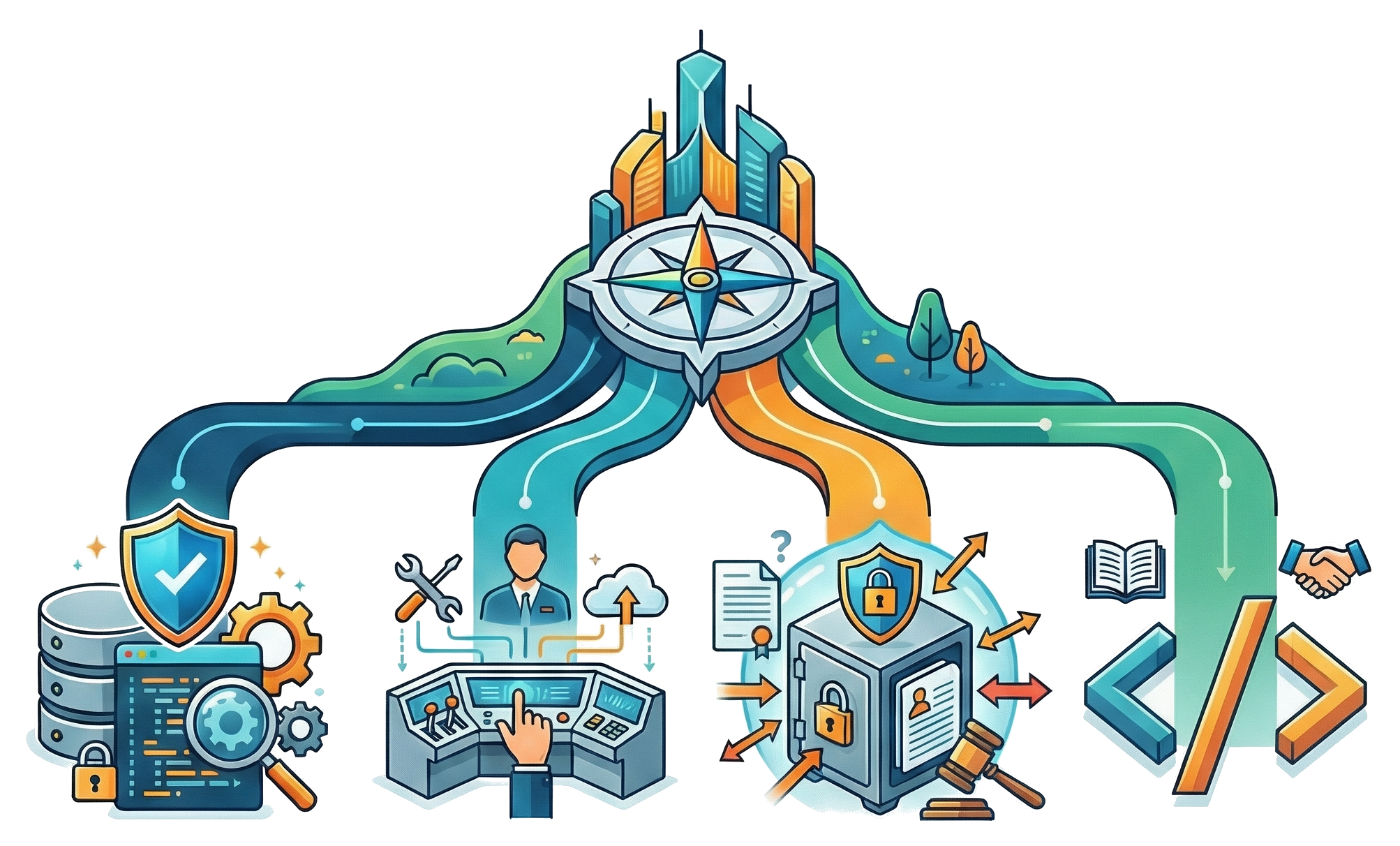
The four pillars of real technological sovereignty
European discussions increasingly refer to four key dimensions that align remarkably well with what gvSIG has defended for years:
1. Security sovereignty
Trust is not enough: verification is essential. The ability to audit code, processes, and security mechanisms is critical, especially in public and regulated sectors.
2. Operational sovereignty
Who operates the system, who deploys it, who can modify it, and under what conditions. Without operational control, sovereignty remains purely theoretical.
3. Data sovereignty
Where data is stored, how it is processed, and—crucially—which external legal frameworks may affect it, often without users even realising it.
4. Technical sovereignty
Perhaps the most overlooked—and the most important. Using open standards and open source software is not a philosophical stance; it is the only way to avoid irreversible vendor lock-in.
Open source: a necessary (though not sufficient) condition
Open source software does not automatically guarantee sovereignty, but without open source, sovereignty is simply impossible.
Access to source code:
- enables auditing,
- allows adaptation,
- makes long-term evolution possible,
- and allows changing providers without rebuilding everything from scratch.
At gvSIG, we have always defended that technology should serve people and institutions—not the other way around. That is why we are committed to open standards, real interoperability, and technical communities that do not depend on a single company or country.
This is no coincidence.
It is a political decision in the best sense of the word.
An open ecosystem versus structural dependency
Technological sovereignty is not built with isolated products, but with ecosystems: public administrations, local companies, universities, technical communities, and end users collaborating on equal footing.
This approach:
- strengthens local technological capacity,
- reduces systemic risks,
- fosters real competition,
- and enables long-term evolution without being trapped in closed solutions.
Exactly the opposite of becoming a digital colony, as some European representatives have already warned.
gvSIG: technological sovereignty before it became urgent
When gvSIG was created, the dominant discourse was different. The focus was on efficiency, cost reduction, and “not reinventing the wheel”.
Today, without renouncing any of that, we know that the real value lies in autonomy, resilience, and the ability to decide.
Technological sovereignty is not a recent trend for us.
It is the common thread running through the entire project.
And in the coming years, it will likely become one of the most critical debates for Europe’s digital future.


 Alvaro
 Amparo Cisneros
 adelrey
 Alegria
 asoredesocial2006
 Augusta
 christinesig
 cordin
 csanper
 danielvicb
 dispiste
 edmarmoretti
 elenasanchez232
 eliazerk
 fjsolis
 Gabi
Gabi ggowtham
 Giuliano Ramat
 Valenty
 Georg Sedlmeir
 hydrologiclady
 jgalans
 Joaquin del Cerro
 Juan Lucas Domínguez Rubio
 jolicar
 josebadia
 Jorge Piera Llodrá
 Jordi Torres
 Chevi
Chevi learozz
 leoruizb
 Alonso Morilla
 Lluís Marqués
 martapacoret
 Óscar Martínez
 mateoboudon
 Mario
Mario Mario Chaveli
 mjlobato76
 Manuel
 mmontesinos
 moovida
 Nacho Varela
 nbrodin
 André
André piotrpachol
 psanxiao
 Sergio Acosta y Lara
 Spatioblog
 Sergio Acosta y Lara
 uliwerz
 Victor Acevedo
 Viqui
Viqui volaya

 gvSIG blog