
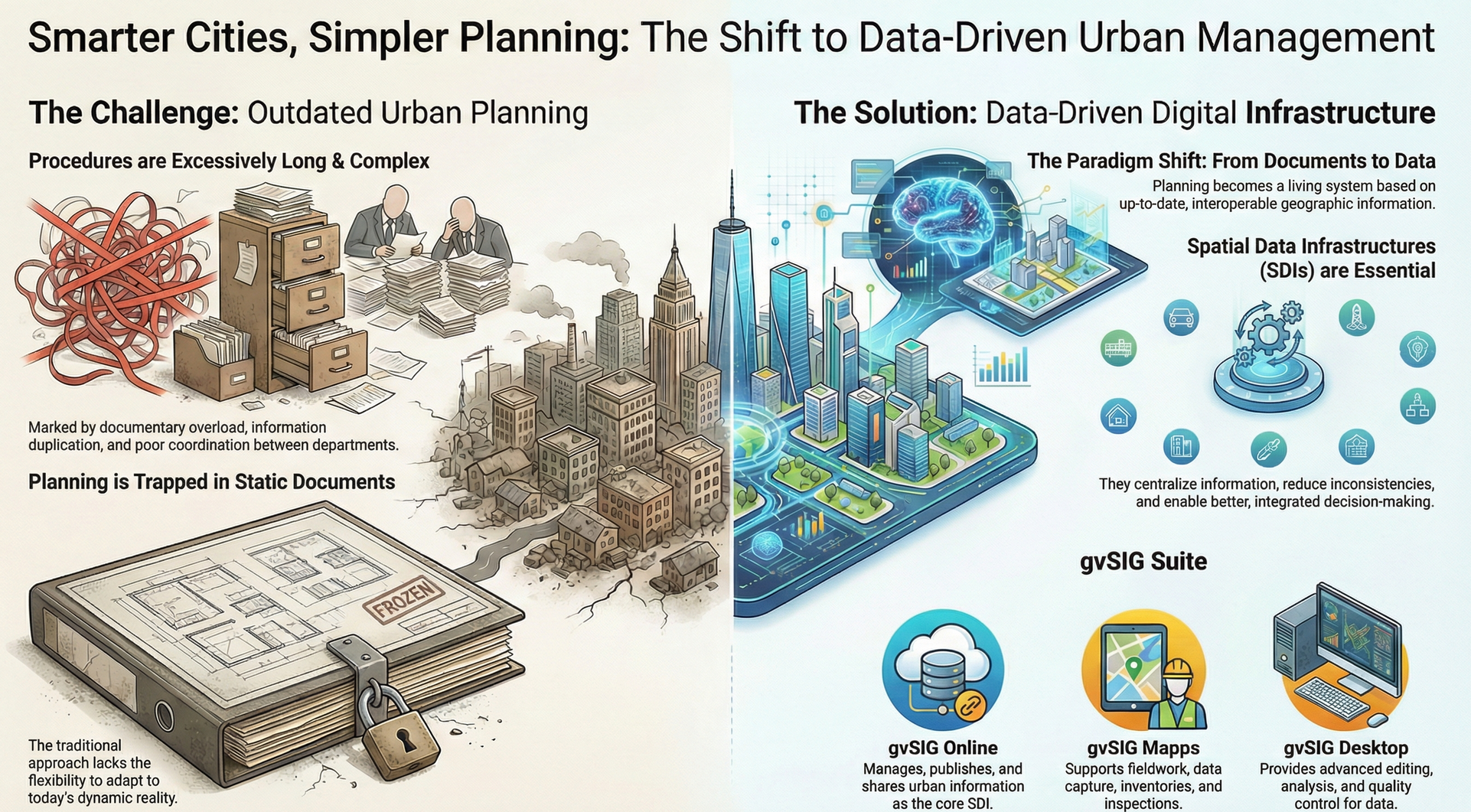
In many countries and regions, public administrations are revising their urban planning and land-use legislation with a shared goal: to simplify procedures, reduce administrative burdens, and adapt territorial management to an increasingly complex and dynamic reality.
The Valencian Community (Spain) is a recent example of this process, with the promotion of a new Land Law based on a widely shared diagnosis: excessively long procedures, documentary overload, duplication of information, and difficulties in coordinating data across departments and administrations. A situation that, to a greater or lesser extent, is repeated in many other territories.
Beyond this specific case, the reform highlights a key idea: regulatory modernisation requires solid digital infrastructures.
From paper-based planning to data-driven urban management
New regulatory approaches increasingly point towards:
- More agile procedures
- More flexible planning frameworks
- Greater emphasis on management and monitoring rather than static documents
- Improved coordination of sectoral reports
This represents a paradigm shift: planning is no longer just a collection of approved documents, but a living system, based on up-to-date, interoperable and reusable geographic information.
SDI as an essential public infrastructure
In this context, Spatial Data Infrastructures (SDI) evolve from being a purely technical solution to becoming an essential public infrastructure, comparable to other core corporate systems used by public administrations.
A municipal SDI enables:
- Centralisation of urban and territorial information
- Reduction of duplication and inconsistencies
- Interoperability between administrations
- Better decision-making through an integrated view of the territory
The gvSIG Suite as a practical response
The gvSIG Suite fits naturally into this scenario, offering a comprehensive solution based on open standards:
- gvSIG Online, as the core of the SDI, for managing, publishing and sharing urban and territorial information.
- gvSIG Mapps, to support field data capture, inventories, inspections and the monitoring of actions and interventions.
- gvSIG Desktop, as an advanced tool for data editing, analysis and quality control, when more demanding analytical or cartographic workflows are required.
Together, these tools cover the entire life cycle of geographic information, from data generation to its use in decision-making and communication with citizens.
A shared opportunity for local governments
Although each territory operates under its own legal framework, the message is widely applicable: simplifying urban management requires well-structured and well-organised information — and much of that information is inherently geographic.
Processes such as the one currently taking place in the Valencian Community can therefore be seen as examples that are transferable to other contexts, where SDIs and integrated geospatial platforms become a cornerstone for more efficient, transparent and service-oriented territorial management.
The gvSIG Suite — and in particular gvSIG Online as an integrated solution for territorial information management — is increasingly adopted by local administrations of all sizes, from small municipalities to large cities, provinces and inter-municipal organisations.
Now is the time to join.


 Alvaro
 Amparo Cisneros
 adelrey
 Alegria
 asoredesocial2006
 Augusta
 christinesig
 cordin
 csanper
 danielvicb
 dispiste
 edmarmoretti
 elenasanchez232
 eliazerk
 fjsolis
 Gabi
Gabi ggowtham
 Giuliano Ramat
 Valenty
 Georg Sedlmeir
 hydrologiclady
 jgalans
 Joaquin del Cerro
 Juan Lucas Domínguez Rubio
 jolicar
 josebadia
 Jorge Piera Llodrá
 Jordi Torres
 Chevi
Chevi learozz
 leoruizb
 Alonso Morilla
 Lluís Marqués
 martapacoret
 Óscar Martínez
 mateoboudon
 Mario
Mario Mario Chaveli
 mjlobato76
 Manuel
 mmontesinos
 moovida
 Nacho Varela
 nbrodin
 André
André piotrpachol
 psanxiao
 Sergio Acosta y Lara
 Spatioblog
 Sergio Acosta y Lara
 uliwerz
 Victor Acevedo
 Viqui
Viqui volaya

 gvSIG blog