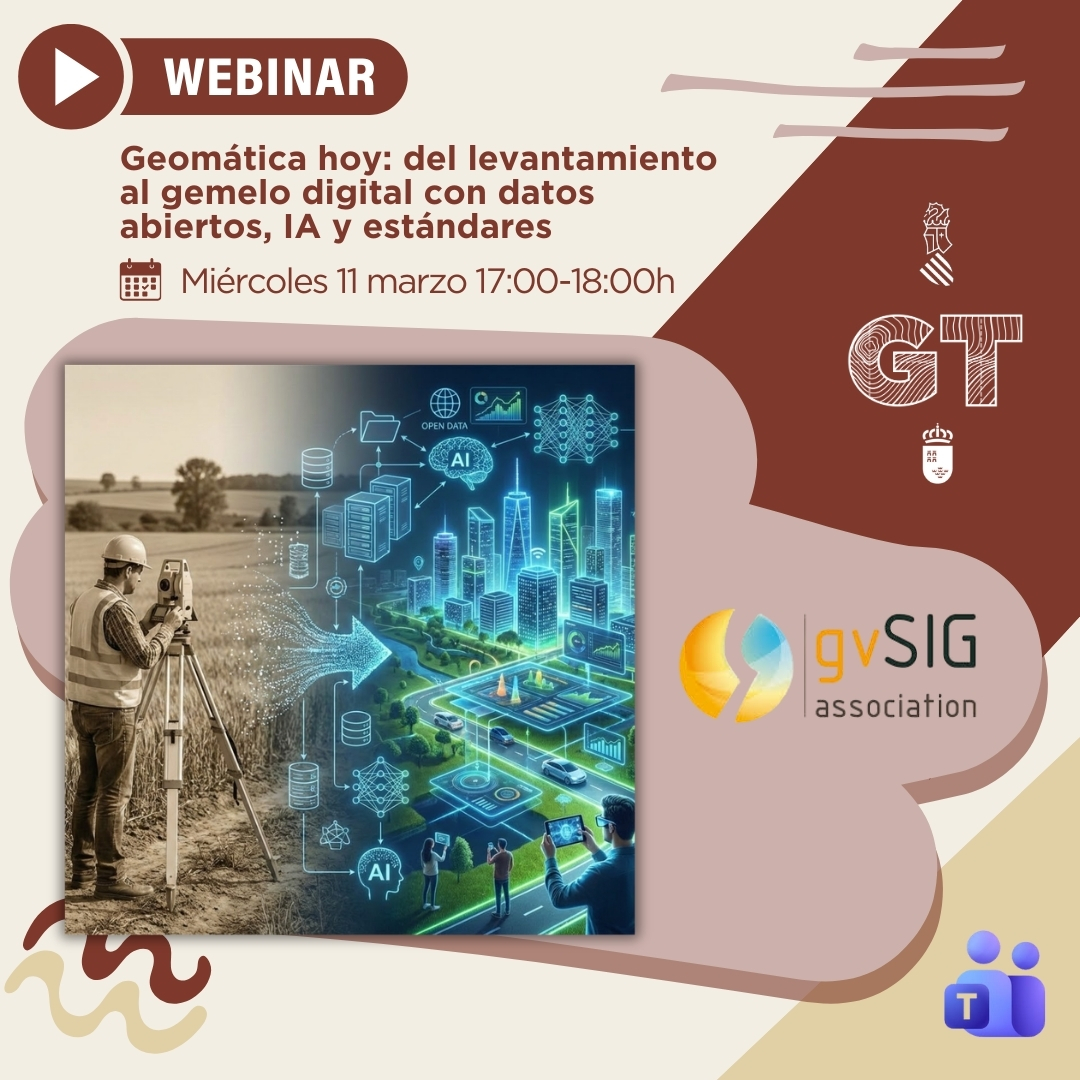
El pasado 11 de marzo tuve el placer de impartir el webinar “Geomática hoy: del levantamiento al gemelo digital con datos abiertos, IA y estándares”, organizado por la Delegación Territorial de la Comunidad Valenciana y Región de Murcia del Ilustre Colegio Oficial de Ingeniería Geomática y Topográfica (COIGT) en colaboración con la Asociación gvSIG.
En la sesión compartí una reflexión sobre cómo está evolucionando la geomática: desde los levantamientos tradicionales hasta enfoques más avanzados basados en datos abiertos, interoperabilidad, análisis geoespacial e inteligencia artificial, que permiten construir desde inventarios territoriales hasta gemelos digitales del territorio para apoyar la toma de decisiones.
Para quienes no pudieron asistir en directo, el vídeo del webinar ya está disponible y puede verse a continuación. Espero que resulte interesante y que sirva para seguir reflexionando sobre hacia dónde está evolucionando nuestro sector.
Hoy tengo el placer de impartir el webinar “Geomática hoy: del levantamiento al gemelo digital con datos abiertos, IA y estándares”, organizado por la Delegación Territorial de la Comunidad Valenciana y Región de Murcia del Ilustre Colegio Oficial de Ingeniería Geomática y Topográfica (COIGT).
La idea de la sesión es compartir una reflexión sobre el momento tan interesante que vive la geomática. Nunca antes habíamos tenido a nuestra disposición tantos datos, tanta capacidad de procesamiento y tantas herramientas para transformar la información geoespacial en conocimiento útil para la toma de decisiones.
Durante el webinar haré un recorrido que conecta la topografía y la cartografía tradicional con tecnologías que hoy forman parte del día a día de muchos proyectos: teledetección, SIG, Infraestructuras de Datos Espaciales, estándares abiertos como OGC e INSPIRE y el papel creciente de la inteligencia artificial en el análisis territorial.
También hablaré de cómo, a partir de datos abiertos e interoperabilidad, se pueden construir soluciones que van desde inventarios y gestión catastral hasta gemelos digitales o cuadros de mando para la gestión del territorio.
Este webinar forma parte de un ciclo organizado por el COIGT, con la idea de compartir experiencias, reflexiones y tecnologías relacionadas con la información geográfica.
Además, en futuras sesiones profundizaremos en algunas de las herramientas del ecosistema gvSIG, como gvSIG Desktop, gvSIG Online o gvSIG Mapps, y en cómo pueden aplicarse en distintos ámbitos profesionales.
La sesión se celebra online entre las 17:00 y las 18:00, incluyendo un turno final de preguntas.
Espero que resulte interesante y que sirva para reflexionar sobre hacia dónde está evolucionando la geomática.
In recent days, the Roadmap to Accelerate Digital Sovereignty in Spain has been presented, a document that reflects something that has been becoming increasingly clear for some time now: digital sovereignty has ceased to be an abstract concept and has become a strategic issue. We are no longer talking only about innovation, but about decision-making capacity, resilience, technological autonomy, and control over critical infrastructures. Technological dependence is a structural vulnerability.
The document points to a key idea: Europe and Spain cannot limit themselves to consuming technologies developed by others. When a public administration, a company, or a public institution depends on technologies it does not control, on platforms it cannot audit, on licences that can change unilaterally, and on infrastructures that respond to external interests, it is not innovating: it is taking on a strategic risk.
And that risk does not affect technology alone. It affects the ability to decide, to plan, to ensure continuity, to protect data, to guarantee public services, and to sustain long-term policies. The question is why we continue to build critical parts of our administrations and organisations on technologies we do not control.
That is why the answer cannot remain at the level of regulation alone. It is necessary to invest, deploy our own infrastructures, strengthen the use of open standards, and promote technological solutions that can be audited, evolved, and governed within our own institutional framework.
In that context, it is especially relevant that the roadmap explicitly mentions the promotion of free software and open source within public administration, as well as the need to connect Spain’s public digital infrastructure with the European one and to strengthen domestic technological capabilities.
That is where initiatives such as gvSIG fully make sense. gvSIG is not just software. It is, and has always been, a practical commitment to digital sovereignty.
Because talking about digital sovereignty also means talking about the concrete tools with which public administrations manage their territory, their information, and their services. It means asking whether an administration can retain control over its geospatial infrastructure, its data, its processes, and the future evolution of its systems.
Today, gvSIG is a suite, a digital infrastructure, a catalogue of solutions based on free software, open standards, and interoperability. It is an ecosystem that enables administrations and organisations to build and maintain their own Spatial Data Infrastructures, geoportals, and territorial management systems without depending on unilateral decisions by third parties, without becoming trapped by restrictive licences, and with a real capacity to adapt over the long term.
A large share of the critical information managed by public administrations has a territorial dimension: urban planning, emergencies, the environment, mobility, cadastre, infrastructure, public services, security, defence… When that technological layer depends entirely on closed vendors, dependency is not only technical: it is also organisational and strategic.
There is a clear risk in continuing to accept as normal a dependency that compromises the autonomy of our institutions.
When Europe and Spain speak about digital sovereignty, public digital infrastructure, free software, and technological autonomy, this is not a debate that is alien to gvSIG. All of this has been part of gvSIG’s DNA for years. We are looking at a framework that reinforces the relevance of projects that have already been demonstrating, in practice, that another way of building technology is possible.
En los últimos días se ha presentado la Hoja de Ruta para acelerar la soberanía digital en España, un documento que refleja algo que desde hace tiempo resulta cada vez más evidente: la soberanía digital ha dejado de ser un concepto abstracto para convertirse en una cuestión estratégica. Ya no hablamos solo de innovación, sino de capacidad de decisión, resiliencia, autonomía tecnológica y control sobre infraestructuras críticas. La dependencia tecnológica es una vulnerabilidad estructural.
El documento apunta a una idea clave: Europa y España no pueden limitarse a consumir tecnologías desarrolladas por terceros. Cuando una administración, una empresa o una institución pública depende de tecnologías que no controla, de plataformas que no puede auditar, de licencias que pueden cambiar unilateralmente y de infraestructuras que responden a intereses ajenos, no está innovando: está asumiendo un riesgo estratégico.
Y ese riesgo no afecta solo a la tecnología. Afecta a la capacidad de decidir, de planificar, de garantizar continuidad, de proteger datos, de asegurar servicios públicos y de sostener políticas a largo plazo. La pregunta es por qué seguimos construyendo piezas críticas de nuestras administraciones y organizaciones sobre tecnologías que no controlamos.
Por eso, la respuesta no puede quedarse en la regulación. Hace falta invertir, desplegar infraestructuras propias, reforzar el uso de estándares abiertos y promover soluciones tecnológicas que puedan ser auditadas, evolucionadas y gobernadas desde nuestro propio marco institucional.
En ese contexto, resulta especialmente relevante que la hoja de ruta mencione de forma expresa el impulso al software libre y al código abierto en la Administración, así como la necesidad de conectar la infraestructura pública digital española con la europea y de fortalecer capacidades tecnológicas propias.
Ahí es donde iniciativas como gvSIG adquieren todo su sentido. gvSIG no es solo software. Es, siempre ha sido, una apuesta práctica por la soberanía digital.
Porque hablar de soberanía digital también es hablar de las herramientas concretas con las que las administraciones públicas gestionan su territorio, su información y sus servicios. Es hablar de si una administración puede mantener el control sobre su infraestructura geoespacial, sobre sus datos, sobre sus procesos y sobre la evolución futura de sus sistemas.
Hoy día gvSIG es una suite, una infraestructura digital, un catálogo de soluciones basadas en software libre, estándares abiertos e interoperabilidad. Un ecosistema que permite a administraciones y organizaciones construir y mantener sus propias Infraestructuras de Datos Espaciales, geoportales y sistemas de gestión territorial sin depender de decisiones unilaterales de terceros, sin quedar atrapadas por licencias restrictivas y con capacidad real de adaptación a largo plazo.
Buena parte de la información crítica de una administración tiene una componente territorial: urbanismo, emergencias, medio ambiente, movilidad, catastro, infraestructuras, servicios públicos, seguridad, defensa… Cuando esa capa tecnológica depende por completo de proveedores cerrados, la dependencia no es solo técnica: es también organizativa y estratégica.
Hay un riesgo claro en seguir aceptando como normal una dependencia que compromete la autonomía de nuestras instituciones.
Cuando desde Europa y desde España se habla de soberanía digital, de infraestructura pública digital, de software libre y de autonomía tecnológica, no estamos ante un debate ajeno, todo eso forma parte, desde hace años, del ADN de gvSIG. Estamos ante un marco que refuerza la relevancia de proyectos que ya vienen demostrando, en la práctica, que otra forma de construir tecnología es posible.
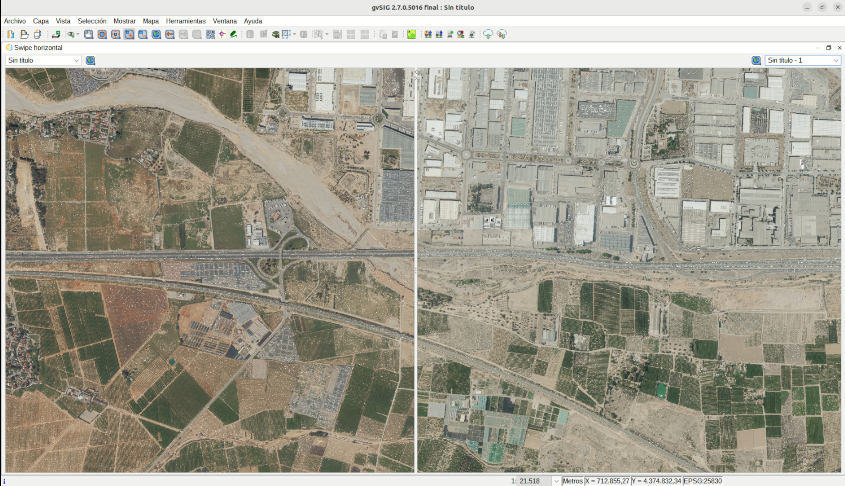
La nueva versión gvSIG Desktop 2.7 incluye la herramienta de Swipe o Cortinilla. Con esta herramienta es posible comparar cartografía diferente de forma sencilla, como por ejemplo dos ortofotos de años diferentes.
El funcionamiento de esta herramienta es a partir de dos vistas diferentes, donde en cada una de ellas se deberá tener una de las capas a comparar. El usuario podrá elegir la opción de realizar cortinilla de forma vertical u horizontal, y se aplicará sobre las capas que se tenga visibles en ese momento en las dos vistas. Una vez seleccionadas ya solo deberá desplazar la barra central horizontalmente o verticalmente para poder ver las diferencias.
What does it mean to speak about European digital infrastructure? It means:
Use of open standards (such as those promoted by the Open Geospatial Consortium).
Compliance with regulatory frameworks such as INSPIRE.
A real possibility of self-hosting.
Independence from unilateral changes in licenses or terms of use.
The ability to audit, evolve, and adapt the system over the long term.
Europe has clearly defined its commitment to the digital commons and technological sovereignty. But that strategy is not materialized through declarations. It is materialized through real infrastructures.
Within this framework, gvSIG is more than a technology: it constitutes a digital infrastructure.
Today, the gvSIG brand represents an ecosystem of solutions — the gvSIG Suite — characterized by being:
Free and open-source software
Standards-based
Modular
Interoperable
Evolvable
Both on the web and complemented by desktop and mobile products, the gvSIG Suite enables the deployment of complete Spatial Data Infrastructures, aligned with European standards and fully controlled by the organization implementing them.
This means:
Own servers or trusted hosting environments
Integration with administrative systems
Adaptation to local regulations
Development of specific extensions
Progressive scalability
No dependencies.
With the gvSIG Suite, we can build a territorial digital infrastructure that:
Enables governance of sensitive data
Ensures long-term continuity
Reduces future risks
Strengthens internal technical capacities
Generates reusable knowledge
In the geospatial domain, the gvSIG Suite has become a structural component of digital public administration.
¿Qué significa hablar de infraestructura digital europea? Significa:
Uso de estándares abiertos (como los promovidos por el Open Geospatial Consortium).
Cumplimiento de marcos normativos como la directiva INSPIRE.
Posibilidad real de autohospedaje.
Independencia frente a cambios unilaterales de licencias o condiciones de uso.
Capacidad de auditar, evolucionar y adaptar el sistema a largo plazo.
Europa ha definido claramente su apuesta por el bien común digital y la soberanía tecnológica. Pero esa estrategia no se concreta en declaraciones. Se concreta en infraestructuras reales.
En este marco gvSIG es más que una tecnología: se constituye como una infraestructura digital. Hoy la marca gvSIG representa un ecosistema de soluciones, la Suite gvSIG, caracterizado por ser:
Software libre y abierto
Basado en estándares
Modular
Interoperable
Evolucionable
Tanto en web como complementada por los productos de escritorio y movilidad, la Suite gvSIG permite desplegar Infraestructuras de Datos Espaciales completas, alineadas con estándares europeos y plenamente controladas por la organización que las implementa.
Eso significa:
Servidores propios o en entornos de confianza
Integración con sistemas administrativos
Adaptación a normativa local
Desarrollo de extensiones específicas
Escalabilidad progresiva
Sin dependencias. Con la Suite gvSIG podemos construir una infraestructura digital territorial que:
Permite gobernar datos sensibles.
Garantiza continuidad en el tiempo.
Reduce riesgos futuros.
Refuerza capacidades técnicas internas.
Genera conocimiento reutilizable.
En el ámbito geoespacial, la Suite gvSIG se ha convertido en un componente estructural de la administración digital.
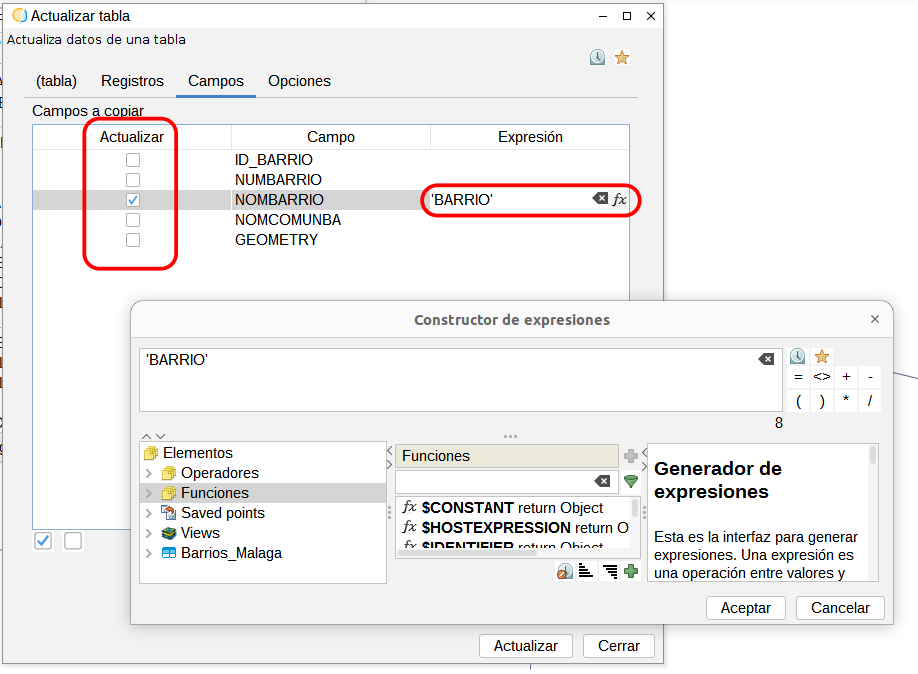
La nueva versión 2.7 de gvSIG Desktop incluye una nueva calculadora de campos, cuyas principales ventajas son, por un lado, que se pueden rellenar varios campos a la vez, y por otro, que ha mejorado significativamente el rendimiento cuando se pretenden rellenar muchos registros a la vez, al no cargarse en memoria todos ellos sino por bloques.
La nueva calculadora se basa en la herramienta de actualizar tabla que se había incluido en la versión anterior, donde se había mejorado la parte de rellenado de registros. Ahora dispone de una pestaña “Opciones” donde se puede seleccionar el número de registros en los que se quiere que termine edición y reinicie. De esa forma no carga todos los datos en memoria y no bloquea el equipo, evitando así también posibles pérdidas de datos.
Por otro lado, permite rellenar varios campos a la vez, cada uno con su fórmula, indicando el usuario qué campos quiere rellenar. Si se tiene seleccionado un campo de la tabla cuando se abre la calculadora de campos, ese es el campo que se queda marcado para insertar la fórmula a ejecutar. Si no se tiene ninguno seleccionado se activan todos, por lo que habría que desactivar los que no se desee rellenar.
Otra novedad es que no hace falta comenzar edición para poder utilizar la calculadora de campos.
En muchas ocasiones, hablar de software libre o de código abierto en proyectos públicos se asocia a innovación. Y aunque es cierto que el acceso al conocimiento permite innovar de forma más eficiente en muchos ámbitos, también suele interpretarse como una apuesta por soluciones alternativas o incluso de riesgo.
Si nunca lo fue, hoy todavía menos: esa lectura ya no encaja con la realidad.
Cada vez más, el verdadero riesgo no está en el software libre. Está en la dependencia.
En proyectos públicos, especialmente en aquellos que gestionan información crítica —y gran parte de lo que ocurre en el territorio y se gestiona desde la geomática lo es— la estabilidad no consiste en que algo funcione hoy. Consiste en que siga funcionando mañana, ante posibles cambios de proveedores, contratos, condiciones de licencia, prioridades políticas o equipos técnicos.
El acceso al código, el uso de estándares abiertos y la posibilidad real de mantenimiento por terceros no son argumentos baladíes. Son mecanismos básicos de control del riesgo. Permiten auditar, evolucionar, integrar y, llegado el caso, cambiar de proveedor sin rehacer el sistema desde cero.
En entornos públicos optar por soluciones cerradas suele ser la decisión más arriesgada.
El software libre es una decisión conservadora en el mejor sentido del término: proteger la inversión pública, reducir incertidumbre y garantizar capacidad de adaptación a largo plazo.
¿Y en cuanto a innovación? Sin control, no hay innovación sostenible.
We are living in a time when almost every territorial project is presented alongside concepts such as artificial intelligence, digital twins or advanced analytics. The message is appealing: prediction, automation, intelligent decision-making.
But there is a less visible and far more decisive reality: these systems only work properly when data is well structured.
AI applied to territorial management does not just require large volumes of information. It requires data that is coherent, comparable and maintainable over time. This is where standards come into play.
INSPIRE is not a “modern” technology, nor does it aim to be one. It is a framework that defines how geospatial data is described, shared and understood across organizations. Precisely for this reason, it becomes essential when the goal is to go beyond isolated, one-off projects.
Without a common framework:
AI models learn from inconsistent data,
digital twins become local representations that are difficult to scale,
each new use case requires integrations and adaptations to be rebuilt from scratch.
With INSPIRE:
data maintains a shared semantics,
analyses are reproducible,
solutions can grow and connect with other systems.
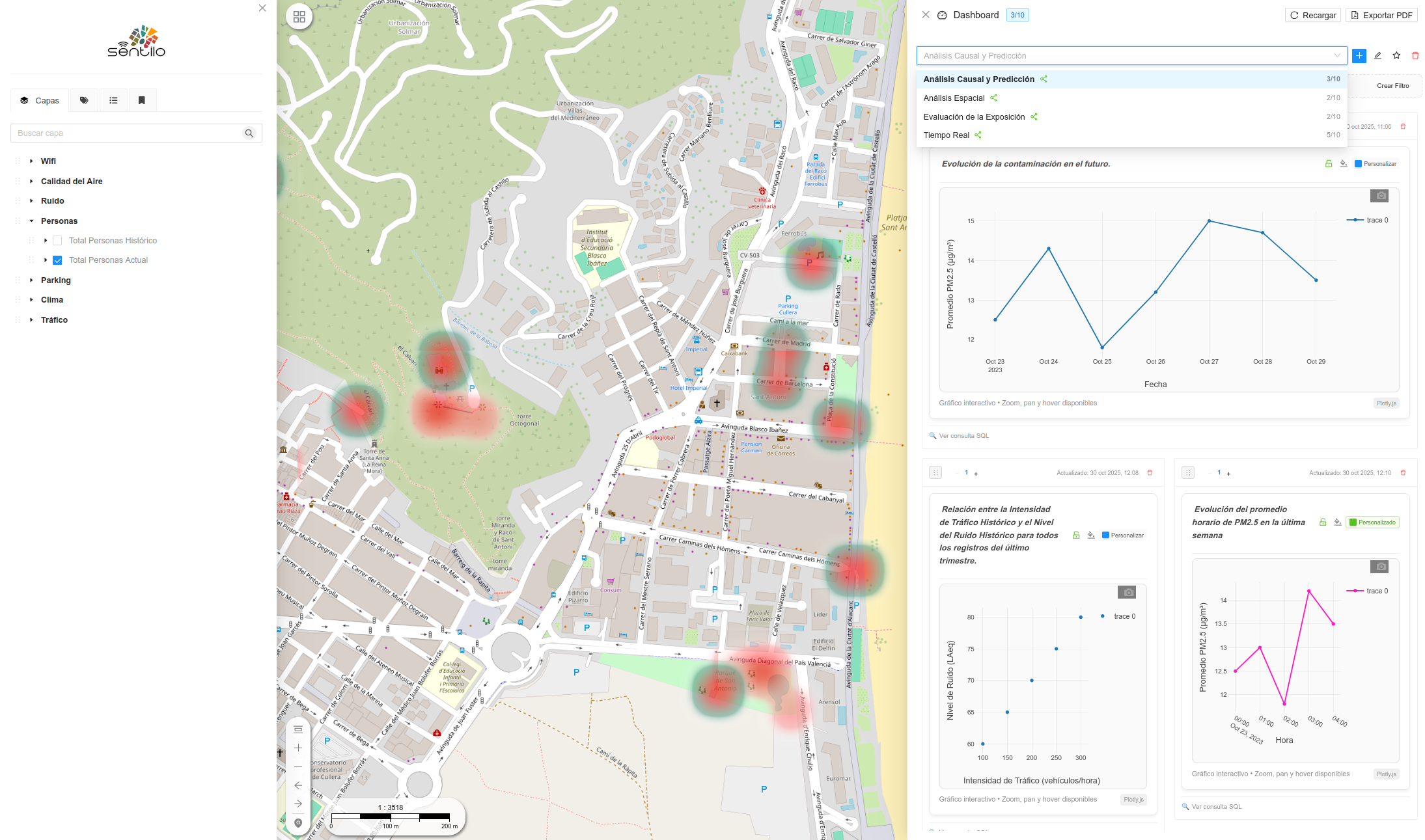
In our case, this foundation has enabled us to integrate artificial intelligence capabilities directly into SDI platforms, to the point of interacting with gvSIG Online using natural language, generating dynamic dashboards, or launching advanced analyses without breaking the coherence of the system.
The more advanced the solutions we want to build on top of the territory, the more we depend on standards that are rarely mentioned.
In upcoming posts, we will go into more detail on how these AI capabilities are being practically integrated into gvSIG Online and how we are applying them across a wide range of projects.





 Alvaro
 Amparo Cisneros
 adelrey
 Alegria
 asoredesocial2006
 Augusta
 christinesig
 cordin
 csanper
 danielvicb
 dispiste
 edmarmoretti
 elenasanchez232
 eliazerk
 fjsolis
 Gabi
Gabi ggowtham
 Giuliano Ramat
 Valenty
 Georg Sedlmeir
 hydrologiclady
 jgalans
 Joaquin del Cerro
 Juan Lucas Domínguez Rubio
 jolicar
 josebadia
 Jorge Piera Llodrá
 Jordi Torres
 Chevi
Chevi learozz
 leoruizb
 Alonso Morilla
 Lluís Marqués
 martapacoret
 Óscar Martínez
 mateoboudon
 mateocb16000
 Mario
Mario Mario Chaveli
 mjlobato76
 Manuel
 mmontesinos
 moovida
 Nacho Varela
 nbrodin
 André
André piotrpachol
 psanxiao
 Sergio Acosta y Lara
 Spatioblog
 Sergio Acosta y Lara
 uliwerz
 Victor Acevedo
 Viqui
Viqui volaya


