On the road to gvSIG 2.3: Dynamic segmentation in 4 videos

Creating Routes:

Calibrate Routes:

Showing measurements:

Dynamic segmentation:


Posted in english, gvSIG Desktop | Tagged , | 2 Comments

On the road to gvSIG 2.3: Dynamic segmentation (VI and final)

Once we have seen in previous post how to create routes, calibrate them and generate the dynamic segmentation, in this last post we will see how to show and clean measure.

Show measures

This tool allows the graphic representation of the M coordinate. To enable this tool, the active layer of the View has to be a layer of lines with M coordinate points. Some element has to be selected.

Once activating the tool, a dialog box is showed which allows to introduce the required distance between the kilometer points.

LRS20

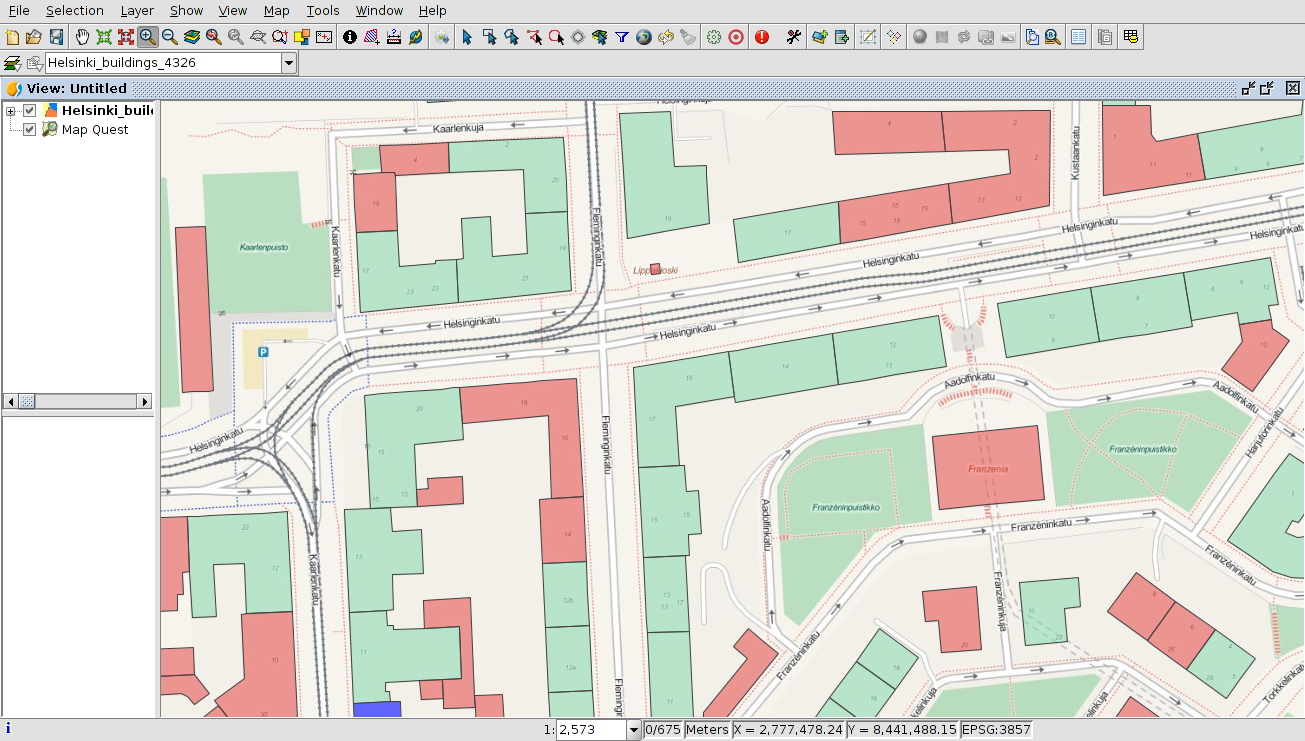
Once accepting, gvSIG will show the point in the route with the set distances and one label with the M coordinate of that point.. The label format will be“# + ###”. So, the kilometer point 2,350 will be “2 + 350”.

0141

This tool show the results in the View without changing any of the data of the used routes.

Clean measures

This tool cleans from the View all the measures previously displayed for the previous tool.

The user could have executed the tool for showing measures as many times or over many routes as wanted, and because they stay in the View and it can be a problem for the correct interpretation of the data, using the clean measures tool, all the measures will be cleared from the view.

Related posts:

Posted in english, gvSIG Desktop | Tagged , , , , | 2 Comments

On the road to gvSIG 2.3: Dynamic segmentation (V)

Once we´ve learned in previous posts how to create routes and calibrate them, let´s see the available tool to generate dynamic segmentation.

This tool allows to create new information layers from a geocodification linked to a linear reference system. For instance, the accident location referred to one road and kp or the representation of capacities or average traffic density of kilometric sections.

To run this tool, it is needed to go from a layer of calibrated routes and one table with columns indicating the kilometric points and columns with other values.

By activating the tool, a dialog box is displayed with the following components:

  • Source” to select the layer of calibrated routes.
  • Route identifier field” to select the table field of the calibrated routes layer containing the identifier of the route.
  • Table” to select the table with values.
  • Route identifier in value table” to select the field of the values table containing the route ID. If it is not selected, either because it does not exist in the table or because it is not desired, all values ​​will be applied to the output for any selected route.
  • Landmark” to indicate the field that will contain the initial kilometer points of each section.
  • “Final Landmark” to indicate the field that will contain the final kilometer points of each section.
  • Value” to indicate the field that will contain the values to represent.
  • Output file” to introduce the layer in which all the results will be kept.

Once accepting this dialog, a new layer will be created with the following characteristics:

  • If the initial  and final landmark fields have been selected, the output layer will be one linear layer with the routes from the original layer separated in the sections indicated by these fields.
  • If only the “Landmark” has been selected, the output layer will be a layer of positioned point in the kilometer points indicated by that field.
  • In the table associated to the output layer, the new columns will be added:
    • registration” or the name of the column of the table from the original layer where the is the route ID.
    • PK”, if the output layer is a point one, or “PK INICIAL” is a linear one.
    • PK FINAL” if the output layer is linear
    • value” or the name of the column from the value table where is the value aimed to be represented.

After this, any of the gvSIG symbologies for linear layers can be applied.

If, before the tool running, the input layer had any selection, this process only will be applied to the selected routes.

The following image is an example of a linear layer generated by dynamic segmentation. A unique value symbology has been applied using the “VALUE”(TIPO) attribute.

LRS_10

The next image is an example of a point layer generated by dynamic segmentation.

LRS_11

Once the process ends, which will be indicated by a dialog box with a progress bar, gvSIG will give to the user the generated layer in the active view.

Related posts:


Posted in english, gvSIG Desktop | Tagged , , , , | 3 Comments

On the road to gvSIG 2.3: Dynamic segmentation (IV)

Let’s continue illustrating gvSIG 2.3 news related to dynamic segmentation; in this article we will see the editing tool that allows route calibration.
This tool allows M coordinate editing of a geometry, either through manual data entry of this coordinate point by point, or by introducing a range of values (initial and final) without having a calibration points layer.
The tool is enabled when the active layer in a View is a linear layer having geometries with M coordinate and in editing mode. When you activate this tool a dialogue box in opens where user has to select the corresponding field to the route ID.
LRS3_en
Once selected the attribute containing the routes identifiers and having accepted the dialogue window, another window will appear making the user able to enter the remaining parameters required by this tool.
LRS4_en

This window contains:

  • A table with columns:
    • “Route ID”
    • “Point” with route vertex order
    • “X” with point X coordinate
    • “Y” with point Y coordinate
    • “M” with point M coordinate
  • “ID” indicating the route ID to be changed. It contains all the selected routes identifiers (in case of no selection, it will be filled with all layer ID).
  • “Minimum” to indicate the value to be assigned to vertex whose order is 0.
  • “Maximum” to indicate the value to be assigned to vertex whose order is the maximum.
  • User may shift values in the boxes “Minimum” and “Max” by pressing the “Invert” button.
  • By pressing “Apply”, the values of the M coordinate in the table will be recalculated according to “Minimum” and “Maximum” entered values.

When user selects a “Id”, the table will be populated with the points values of the corresponding “Id” feature. To help user, when selecting an ID, the corresponding route will be highlighted in yellow in the view.
User can manually edit one or more of the M values in the table. As user help, any time you select one or more rows in the table, red dot will be drawn in view in the coordinates corresponding to the vertex being edited.
LRS6_en
Instead of hand editing some points, it is possible to make the tool calculate them based on a values range by changing the “Minimum” and “Maximum” table values. Pressing on “Apply”, the M values are recalculated in the table.
By click on Ok in this window, the tool will check that the M values form an ordered sequence, as well as presence of repeated or negative values. If these value are correct, user may go back before saving changes.
By accepting this dialogue, the M fields values will be permanently assigned to the route points only after having accepted the changes.
LRS7_en

Related posts:

Posted in gvSIG Desktop | 4 Comments

Disponible gvSIG 2.3 RC1, distribución candidata a final

Tal y como anunciamos en su momento, el pasado diciembre se comenzó el proceso de estabilización de la próxima versión de gvSIG, la 2.3. Ha llegado el momento de anunciar la primera RC (Release Candidate) o versión candidata a final. Es el momento de que la Comunidad gvSIG nos ayude a testear y depurar esta versión para tener lo antes posible la final.

Como muchos de vosotros ya sabréis las versiones impares de gvSIG conllevan cambios no sólo a nivel funcional, sino que también se realizan cambios a nivel de arquitectura de la aplicación. Esto implica que es necesario un testeo más profundo para identificar todos los posibles errores derivados de esta re-arquitectura.

Las principales novedades a nivel arquitectura de gvSIG están relacionadas con la generación de versiones para Windows 64 bits y MAC OS X, y son:

  • Acceso a ráster a través de GDAL
  • Soporte de proyecciones a través de GDAL
  • Soporte a multigeometrías

Desde el punto de vista del usuario, las principales novedades son:

  • Lectura y escritura de formato PRJ (proyecciones). A partir de esta versión gvSIG identificará automáticamente el sistema de proyección de una capa si dispone del archivo PRJ. ¡Una de las funcionalidades más demandadas por la comunidad!
  • Segmentación dinámica/Sistema de Referencia Lineal (LRS). Hemos escrito varios post relacionados con estas nuevas herramientas en 1, 2, 3, 4, 5, 6 y 7
  • Nuevas herramientas de edición: cambiar sentido, curva a polilínea, línea paralela
  • Añadir capa al localizador desde la tabla de contenidos
  • Mejoras de scripting. En las pasadas Jornadas Internacionales de gvSIG hubo una ponencia con algunas de las mejoras que vienen.
  • Soporte de R a través de scripting. Soportamos el lenguaje de programación de análisis estadístico por antonomasia.
  • Mejoras PostGIS. Se han implementado diversas mejoras para mejorar la experiencia del usuario y el soporte de base de datos PostGIS.
  • Soporte CSW 2.0.2. Actualización de las versiones de catálogo soportadas.
  • Soporte de nuevos formatos a través de GDAL/OGR. Gracias a los cambios realizados en arquitectura vamos a poder aprovechar el potencial de GDAL/OGR para acceder a todo tipo de formatos hasta ahora no soportados como Geojson, MIF/MID y TAB de Mapinfo, etc.
  • Mejoras de usabilidad. Versión a versión vamos dedicando recursos a mejorar la usabilidad de gvSIG.
  • Actualización de idiomas.
  • Nuevo instalador compatible con 64 bits.
  • Disponible distribución para Windows 64 bits.
  • Generador automático de distribuciones.
  • Generador automático de paquetes Debian.
  • …y un buen número de errores (bugs) que han sido corregidos.

Aunque ya hemos identificado algún error a corregir para la final, hemos decidido publicar ya esta primera RC, ya que nos interesa que empiece a probarse de forma masiva por la Comunidad gvSIG .

También estamos preparando en paralelo la versión para MAC OS X, que esperemos que pueda estar lista para las siguientes RC’s.

¿Dónde descargar gvSIG 2.3 RC1?

Desde la página de versiones en desarrollo de gvSIG.

En unos días también tendremos disponibles en el mismo enlace las versiones portables.

Cualquier error que encontréis podéis enviarlo a través de la lista de usuarios. ¿Cómo enviar un error? Lee este post y te quedará claro lo que necesitamos que nos cuentes:

https://blog.gvsig.org/2015/06/15/que-hacer-cuando-sale-un-error-en-gvsig/

Y ahora os dejamos, que tenéis que probar la RC1…

Posted in gvSIG Desktop, spanish, testing | 3 Comments

gvSIG 2.3 RC1 available, release candidate to final version

As we announced some time ago, last December we started the stabilization process of the next gvSIG version, 2.3. Now we announce the first RC (Release Candidate). This is the moment at which the gvSIG Community helps us to test and refine this distribution to have the final one as soon as possible.

As most of you know, odd gvSIG versions have changes in a functional level, but also in an architecture level. It implies a more detailed testing to identify all the possible errors derived from this re-architecture.

The main novelties in an architecture level are related with the generation of Windows 64 bits and MAC OS X versions, and they are:

  • Access to raster files through GDAL
  • Projection support through GDAL
  • Multi-geometry support

From the users point of view, the main novelties are:

  • PRJ format (projections) reading and writing. From this version, gvSIG will identigy the projection system of a layer automatically if it has a PRJ file. One of the most demanded functionalities by the community!
  • Dynamic segmentation/Linear Reference System (LRS). We’ve written several posts related to these new tools.
  • New editing tools: change sense, curve to polyline, parallel line
  • Add layer to locator from Table of Contents
  • Scripting improvements. There was a presentation about some of the next improvements in the last International gvSIG Conference
  • R support through scripting. gvSIG supports the main programming language for statistical analysis.
  • PostGIS improvements. Several improvements for user experience have been implemented.
  • CSW 2.0.2 support. Catalog versions have been updated.
  • New formats support through GDAL/OGR. Thanks to the architecture changes gvSIG will take advantage of the GDAL/OGR potential to access to different formats not supported like Geojson, MIF/MID and TAB (Mapinfo), etc
  • Usability improvements. We are dedicating resources to improve the gvSIG usability.
  • Language update
  • New installer compatible with 64 bits
  • Windows 64 bits distribution available
  • Distributions automatic generator
  • Debian packages automatic generator
  • …and a great number of errors (bugs) that have been fixed.

Even we’ve identified some error to be fixed for the final version, we’ve decided to release this first RC because we are interested in the testing done by the community.

We also are preparing the version for MAC OS X in parallel, that we hope it will be available for the next RC’s versions.

Where can you download gvSIG 2,3? You can do it from the development versions section of the website.

In some days we will have the links for portable versions too.

Any error that you find can be sent to the mailing list. How can you send an error? You can consult this post, where we explain what information we need: https://blog.gvsig.org/2015/06/17/what-to-do-when-we-get-an-error-in-gvsig/

And now you can test the RC1 version

Posted in community, english, gvSIG Desktop, testing | 2 Comments

Hablando del modelo gvSIG en la radio

TYSC-21-de-Febrero-de-2016-web

El pasado domingo tuve de nuevo una experiencia radiofónica, en este caso dentro del programa “Tecnología y sentido común” dedicado en esta ocasión a hablar del software libre.

Fue un auténtico placer poder compartir un par de horas de tertulia radiofónica escuchando a auténticos expertos y permitiéndonos explicar el modelo de producción de software, basado en la colaboración y el conocimiento compartido, que estamos desarrollando en la Asociación gvSIG.

No siempre que se habla de software libre se hace en un marco en el que se visualiza la importancia del negocio como elemento fundamental para su éxito. Un excelente programa para reflexionar sobre los pasos que han de darse para seguir avanzando.

Tenéis disponible el Podcast del programa en:

http://www.ivoox.com/tecnologia-y-sentido-comun-tysc-21-febrero-2016-audios-mp3_rf_10554127_1.html

Posted in opinion, press office, spanish | Tagged , , | 1 Comment

Change of Productivity Model

Strategic sectors, the ICTs and the 21st Century; the Geomatics, gvSIG and the Spatial Data Infrastructures; Standards, Free and Open Source Software, to share and to collaborate; Neutrality, Independence and Technological Sovereignty; and of course, the change of Productivity Model.

How many things we hear about. How many concepts, how many labels, how many good intentions.

I think nobody is going to deny the importance that the ICTs nowadays have, as they are broadly considered the strategic sector of the 21st Century. At this moment we can’t imagine any productive, economic, academic nor social process in which the ICTs don’t play a essential role. But the question is: Are we aware of what this involve?

I guess we wouldn’t be able to find many people that doubt about how important is for any organization -be a nation, a public administration or a company- to have complete control over the technology, instead of being controlled by the technology or, much worse, by their owners.

We don’t need to be experts in this sector to see the potential that the introduction of the “Geo” component into our Information systems has. In a world where the reality is closely related to the territory, tools that allow us to manage the territory are tools that allow us to manage the reality. We are talking about Geomatics.

If we use our imagination just a little we can think about the Scientific Progress history, in which traditionally the main achievements came thanks to the fact that the giants of the science were able to benefit from studies and findings of their counterparts. We are talking about sharing the knowledge. We are talking about collaborating for reaching solutions. To Share and to Collaborate, core values of the Free and Open Source Software. Free and Open Source Software as a tool of technological progress.

I bet a thousand gvSIG licenses that all of you have heard about the Change of Productivity Model. We’ve been talking about the crisis as long as talking about the Change of Productivity Model, about leaving the bubble sectors and go for the mentioned change where, with no doubt, the ICTs and the R&D&I must play an essential role.

Ok, so we have the ICTs as Strategic Sector, the potential of the Geomatics and gvSIG (project from which the gvSIG Association was born, an international reference in the geospatial technologies sector) on the shoulders of giants (collaboration and sharing, the Free and Open Source Software core values). At this point, can we get any conclusions that help us to turn into reality the Change of Productivity Model? Any Opportunity in front of our face?

PS: For the forgetful ones: It’s not the Neutrality. It’s the Independence, sleep-walkers.

Posted in english, opinion | Leave a comment

Conocer para Transformar o de los fines y los medios

Es muy común el debate en torno al fin y los medios. Muchas veces nos encontramos en la necesidad de aclarar que el Software en sí mismo no es un fin, sino un medio para conseguir algo. Esto como enunciado parece muy lógico, muy claro, pero no es nada raro analizar proyectos de Software donde un peso excesivo o incluso único de la vertiente técnica en la dirección del proyecto termina convirtiendo el Software en un fin en sí mismo.

Lo mismo podemos hablar de la tecnología. ¿Que rol juega la tecnología? Porque parece claro que una vez más debiera ser un medio, pero en el día a día existen muchos ejemplos que parecen querer convertir también a la tecnología en un fin en sí misma alejada de los objetivos finales para los que en teoría es concebida y desarrollada.

Algo parecido observamos con el fenómeno de las redes sociales, donde en vez de interpretarse como una herramienta más se terminan interpretando como que son esas redes sociales el motor de una transformación. Una vez más, lo que debería ser natural y es ver las redes sociales como una herramienta, termina convirtiéndose en un fin en sí mismo.

Software, Tecnología, Redes Sociales. Pero elevemos el nivel de abstracción, seamos capaces de generalizar más. Hablando de Software Libre, es decir de Conocimiento Compartido, ¿Cómo consideramos el conocimiento respecto a la cuestión de la finalidad?

¿Conocer es un fin en sí mismo o es un medio? Y si es un medio. ¿Un medio para conseguir qué?

De forma intuitiva podemos considerar que para Conocer se debe estudiar, interpretar, analizar, desarrollar. Pero hay muchas cosas sobre las que investigar, hay muchas cosas que Conocer. ¿Sobre qué se decide investigar?

Habrá mucha gente que a nivel individual podrá tener el privilegio de decidir sobre lo que quiere investigar, pero nos interesa analizarlo como proceso colectivo, hacia donde se dirige la investigación que aumenta nuestra cantidad de conocimiento adquirido.

Ese hacia donde no ha sido el mismo en todos los momentos de la historia. Por ejemplo, hubo períodos en Europa donde grandes pensadores se centraban en demostrar la existencia de Dios a partir de métodos científicos. Hubo otro momento histórico donde esa idea de Dios como motivo central de la investigación fue reemplazado por el ser humano, pasando a ser éste el motivo principal de la investigación.

Pero sea cual fuera el momento, frente a interpretaciones que quieran dotar un carácter objetivo, neutral y casi aséptico a la Ciencia, el desarrollo de ésta siempre ha tenido unas motivaciones, un Para Qué. Estuviera en el centro de esa investigación la existencia de Dios o el desarrollo humano siempre hubo una motivación a la hora de decidir donde invertíamos para Conocer.

Software Libre como Conocimiento Compartido. Lo de compartir está claro, aquí la pregunta es ¿Conocer qué para conseguir qué?

El Conocimiento no debiera ser algo que se busque por la satisfacción personal o colectiva de ‘ser más listos’, de saber más, de acumular más Conocimiento como si estuviéramos acumulando más Capital. El Conocimiento se debería plantear como un mecanismo para resolver cosas, para dar soluciones que resulten útiles o de interés.

Bien, sigamos preguntándonos. ¿Cosas que sean útiles y de interés para qué y para quienes? Pues no le demos más vueltas y no compliquemos lo que es sencillo. Útiles y de interés para la gente, para ayudar a resolver los problemas. Para Transformar sus realidades en nuevas realidades que resulten mejores para todos.

Y si hablamos de las realidades de la gente, entonces hablamos de lo que les puede aportar e incidir; tanto la realidad científica como la económica y la social o política.

Ciencia, Economía y Política. Disciplinas relacionadas que configuran una realidad global. Disciplinas que deberían evolucionar de manera que la gente pueda interactuar en unos escenarios que cada vez ofrezcan mejores condiciones y posibilidades para el desarrollo humano.

Conocer para que el desarrollo Científico esté al servicio de la humanidad, Conocer para que la Economía responda a patrones de eficiencia y de justicia. Conocer para que la Política nos haga avanzar en cotas de democracia y solidaridad. Este es el Conocer para Transformar por el que se debería apostar.

@GabrielCarrionR

Posted in opinion, spanish | Leave a comment

On the road to gvSIG 2.3: Dynamic segmentation (III)

In this third article about the new dynamic segmentation plugin, the tool to calibrate routes will be detailed.

This tool allows users to assign kilometer points information to a path that is to geocode road elements from their pk’s.

To proceed to calibration, two information layers are required: the route, obtained with the path creation tool, and a calibration points (pk’s) layer with the route identifier and an attribute that indicates the measurement value.

The tool is enabled when active View contains a linear layer of geometries with M coordinate and a point layer.

When activated, the following dialog where user can enter the required parameters for operation is shown

LRS2_en

User can define:

  • Source: input lines layers list with coordinates M that are loaded in gvSIG will be displayed.
  • Route identifier field: the field in the route layer table that contains the route identifier. It displays the list of attributes in the table corresponding to the selected one in “Routes Layer”.
  • Calibration points layer: the input calibration points layer. It will list the points tables that are loaded in gvSIG and have a numeric attribute.
  • Route identifier in calibration points layer: the field of the calibration points layer table that contains the route identifier. It will show the list of attributes of the table corresponding to the selected “Layer calibration points”.
  • From-measure or length field: field in the calibration points layer table that contains the measured values. It displays the attributes list of the table corresponding to the selected one in “Calibration points layer”.
  • Output file: the file where the results will be saved.
  • Measurement Calculation method: it allows users to choose between Distance (The measurements will be recalculated using the shortest distance between the calibration points through the route to calibrate) and Measurements (The measurements will be recalculated using the existing measurement between calibration points).
  • Search radius: the maximum distance where a route calibration point can be located to be included in the calibration calculation. The default value is “0” meaning that points not placed on the path will not be considered for this calibration.
  • Interpolate between calibration points: allows to indicate that existing vertices between the calibration points are interpolated to assign M coordinate.
  • Extrapolate before calibration points: allows to indicate that existing vertices before calibration points are extrapolated to assign M coordinate.
  • Extrapolate after calibration points: allows to indicate that existing vertices after calibration points are extrapolated to assign M coordinate.
  • Ignore spatial gaps: allows you to decide whether or not to take into account the holes size that may exist between the route segments. If checked, distance between the last vertex of a section and the first of the next will not be considered; if not checked, the distance between them will affect the calculation of coordinate M of the first vertex (and following ones) the next segment.
  • Include all elements in output layer. If selected, the routes not been supplied with calibration points will be included in the output file.

The calibration process can be performed over the entire layer or on the selected routes.
Related posts:

Posted in english, gvSIG Desktop | 5 Comments