Why a SME could be interested in joining the gvSIG Association in the current financial crisis situation.

Here you are the translation (or as my colleague Jorge Sanz said: the attempt of translation 🙂 ) of the Gabi’s latest post about the gvSIG Association.
Hope you can understand everything.
 
Manuel.

————-

Nowadays we are in an international financial crisis, mainly in the EU and in the USA, which have been the reference nodes in terms of economic development during the last decades.

The economic system’s crisis is generating a everyday life’s collapse, reflected in a higher unemployment, lower wages, as well as in a deteriorated education and health systems, among other effects.

An environment of crisis and uncertainty that, of course, also affects companies.

The ICT sector is going through bad times because one of their best customers are the Public Administration, which go through a budget cuts, affecting its competency of hiring. And it is in these times of scarcity, where only the strong ones prevail and on the other hand, all those which are not prepared for this situation have difficulties to carry on their business and even some of them disappear.

A lot of SMEs that during years have built a solid and professional status, are now in a critical situation that breaks into pieces all the work done.

In a new situation like that it is necessary, more than ever, to look for new formulas to prevent that the crisis affects the same as always: the majority, because as we all know, there are always small groups that in a crisis situation do not stop increasing their profits.

And also formulas for the SMEs in order to face better the current crisis situation.

Although the gvSIG Association from its very beginning (2007), when the crisis situation was not so evident as now, promoted a model where there is a close and direct relationship between Open Source and the development of a new business model based on values such as: solidarity, collaboration and sharing knowledge, it seems that nowadays it makes much more sense to move forward a model like that.

Unless you are well located in the small elite that manage the system, the only way for surviving or even grow in the current situation is to optimize resources, achieve results, be efficient, create new opportunities, exploit them, be able to neutralize threats and transmit strength.

To achieve that, the gvSIG Association proposes new forms of organization, where the shared knowledge and the other mentioned values are extrapolated to the world of the SMEs and became an engine of scientific progress.

We met again with a statement, much easier to be said than to be done. There are many prejudices. Many SMEs that are even suffering draconian conditions from their transnational partners, have trouble thinking about that another business ethics is not only possible, but necessary.

We insist, that it is much easier to say it than to do it. But what we have very clear, is that the gvSIG Association intends to bring a new organizational way, where the SMEs which opt for FOSS4G have better conditions to generate business and be profitable.

We aim that the ITC PYMEs of the Geomatics Sector look at the gvSIG Association as an attractive meeting point for seeking new business opportunities.

Actually we are not reinventing the wheel, just remembering the quote from the Greek fabulist Esopo: “Unity is strength”.

Posted in english, gvSIG Association | 2 Comments

Por qué en la actual situación a una pyme le puede interesar estar en la Asociación gvSIG

Nos encontramos en un momento de crisis internacional, especialmente en la Unión Europea y Estados Unidos, que han sido los polos de referencia en términos de desarrollo económico en las últimas décadas.

Esta crisis del sistema está generando un colapso que en la cotidianeidad se refleja en más paro, menos salarios, deterioro de los sistemas educativo y sanitario entre otros efectos.

Una situación de crisis e incertidumbre que por supuesto afecta también a las empresas.

El sector TIC se resiente de gran manera ya que su mejor cliente, las instituciones públicas, sufren unos recortes presupuestarios que inciden en su capacidad de contratación. Y es en estos momentos de escasez donde suelen prevalecer los fuertes, los poderosos, de manera que los que no está preparados para afrontar esta situación terminan pasándolo mal cuando no desapareciendo.

Muchas pymes que hasta hace poco tenían un discurso que creían sólido y con buenos profesionales pasan de la noche al día a tener vías de agua que pueden terminar hundiendo la nave.

Es en una situación como ésta cuando más necesario se ve acudir a nuevas fórmulas.

Fórmulas que puedan conseguir que la crisis no la paguen siempre los mismos, la mayoría, pues ya sabemos que siempre existen pequeños grupos que en plena crisis no paran de seguir aumentando sus beneficios.

Y también fórmulas que permitan a las pymes afrontar mejor la situación actual. Y es ahí dónde el modelo de la Asociación gvSIG encaja a la perfección.

Este modelo surgió en un momento (2007) donde la situación de crisis no era tan evidente como la que estamos viviendo actualmente, no obstante, es quizá ahora cuando cobra un mayor sentido ir hacia un modelo donde exista una relación directa y estrecha entre el Software Libre y el desarrollo de un nuevo modelo de negocio basado en valores como la solidaridad, la colaboración y el conocimiento compartido.

Para permanecer e incluso crecer en la actual situación, o bien estás situado en la reducida élite que maneja el sistema o se necesita optimizar recursos, conseguir resultados, ser eficientes, crear nuevas oportunidades y aprovecharlas, ser capaces de neutralizar las amenazas, transmitir fortaleza, y todo esto proponemos conseguirlo yendo a nuevas fórmulas organizativas donde los mismos valores del conocimiento compartido como motor del progreso científico se extrapolen al mundo de las pymes.

Nos encontramos nuevamente ante una declaración que es mucho más fácil de decir que de hacer. Son muchos los prejuicios existentes. Son muchas las pymes que aun viendo que siguen sufriendo leoninas condiciones de aquellas transnacionales de la que son partners, les cuesta pensar que otra ética de los negocios no sólo es posible sino necesaria.

Insistimos, es más fácil de decir que de hacer, pero lo que si tenemos muy claro es que la Asociación gvSIG pretende aportar una nueva fórmula organizativa donde las pymes que apuestan por la geomática libre se encuentren en mejores condiciones para generar negocio y ser rentables.

Pretendemos que las pymes TIC del mundo de la geomática visualicen la Asociación gvSIG como un punto de encuentro que les resulte atractivo y generador de nuevas oportunidades.

Realmente tampoco inventamos nada nuevo, tan sólo recordamos la cita del fabulista griego Esopo: “La unión hace la fuerza”.

Posted in gvSIG Association, opinion, spanish | 4 Comments

Compte-rendu de la première journée des utilisateurs francophones de gvSIG

Auteur: Florent Demoraes, Laboratoire ESO-Rennes (UMR 6590 CNRS) – Université de Rennes 2

Bonjour à toutes et à tous,
voici un bref résumé, avant la trêve estivale, sur le déroulement de la première journée des utilisateurs de gvSIG, organisée par l’association gvSIG, le département de géographie de l’Université de Rennes 2 et le laboratoire ESO-Rennes (UMR 6590 CNRS), à l’Université de Rennes 2, le vendredi 1 juillet dernier. Cette journée a également bénéficié du soutien de la société Alkante.

La première journée des utilisateurs francophones de gvSIG a donc été l’occasion de dresser un bilan des usages et des contributions actuelles des francophones à ce projet. Elle a aussi été l’occasion d’échanger sur l’évolution possible de ces initiatives dans l’espace francophone. Les diaporamas des interventions sont disponibles sur le site de la journée, au site du programme.

La participation en présentiel a été plutôt modeste (26 personnes), mais l’évènement ayant été retransmis en direct sur Internet, l’audience a été en réalité plus large. En effet, nous avons enregistré 245 connexions avec un pic à 10h35 (24 connexions en simultané). Les vidéos sont disponibles sur le site web de la journée.

Après une inauguration par Olivier David (directeur du laboratoire ESO-Rennes) et Loïc Rivault, co-directeur du département de géographie de l’Université de Rennes 2, la parole a été donnée à Olivier Bedel (société Alkante). Son intervention a porté sur un exemple de mise en œuvre d’une application métier reposant sur la solution logicielle gvSIG : le SIG Transport Urbain du Ministère des Transports en Algérie.

Yves Baudouin, département de géographie de l’UQAM (Québec) a ensuite développé l’utilisation de gvSIG comme outil d’apprentissage au département de géographie de l’Université du Québec à Montréal.

Après une pause café, Fabien Guerreiro (Institut Eduter, France) a exposé un témoignage intitulé : gvSIG, outil d’aide à la décision pour le pilotage de structures de l’enseignement et de la recherche (MAAPRAT).

L’après-midi, la délégation espagnole composée de Victoria Agazzi (responsable de la coordination des communautés – Association gvSIG) et Gabriel Carrión (Directeur de la stratégie – Association gvSIG), étant finalement arrivée (la connexion Valencia-Rennes a une fois de plus été épique!), nous avons eu droit à une présentation de l’association gvSIG et à un exposé sur l’évolution du projet gvSIG : portage politique et communautés. S’en est suivi un débat sur des questions de développements, sur des questions d’organisation des communautés et sur des thèmes pédagogiques.

Parmi les attentes qui ressortent de la communauté francophone, un besoin fort a été exprimé pour doter gvSIG d’une fonctionnalité permettant de lire et écrire des fichiers au format MapInfo. A ce titre, si vos institutions respectives expriment également ce besoin, il pourrait être envisagé de faire un appel de fonds pour mutualiser le coût d’un tel développement. De même, si des personnes sont intéressées pour l’élaboration d’un cahier des charges, elles sont les bienvenues.

Enfin, l’idée a également été évoquée de mettre en place une liste de diffusion francophone. Pour en faire partie, veuillez adresser un courriel à Victoria Agazzi (vagazzi [at] gvsig [dot] com).

Pour celles et ceux qui n’ont pas pu être présent(e)s à Rennes, une rencontre des utilisateurs francophones en marge des prochaines journées internationales de gvSIG à Valence (Espagne) en décembre prochain est prévue.

Bonnes vacances pour celles et ceux d’entre vous qui en prennent.

Site web : http://www.gvsig.org/web/community/comm_groups/comm_gvsig_fr/

Posted in community, events, french, gvSIG Association | Tagged | 5 Comments

Explaining what the gvSIG Association is

This is an attempt to translate into English the last post from Gabi about what the gvSIG Association is. I’ve done my best to keep the meaning of his post and I apologize for any misunderstanding. Bold and italics are mine to emphasize some of their texts, as I consider them specially important to understand what are we doing at gvSIG Association.

Cheers
Jorge


There is a lot of information about the gvSIG Association publicly available for anyone who wants to consult and study. [1]

Of course, there will always be so much to explain and interpret. We believe that to understand better the gvSIG Association it’s interesting to explain on a very clearly way how the gvSIG Association sees Free Software.

How we interpret Free Software

At gvSIG we support a professional development model of Free Software in the field of geomatics. The gvSIG Association’s mission is to evolve gvSIG, to ensure software quality, to guarantee the existence of professional services (support, consultancy, etc.). and finally the sustainability of the project. To this end, the Association is responsible for coordinating efforts and ensuring consistency of growth and dissemination.

There may be people who devote part of their free time to work with Free Software projects and we really agree that. It happens that many of these people have to use proprietary software at work and in their spare time they enjoy to devote some time to Free Software projects.

We want to help people to work professionally with Free Software and if someone wants to pursue her commitment to Free Software also on his spare time, that’s perfect. But we insist, the Association claims that people should work professionally with Free Software and that this will happen with the construction of a new model of production/development/business where values ​​such as cooperation, solidarity and knowledge sharing are essential. Because ultimately, software is a means and not an end in itself.

Another objective of the Association is to ensure that the work of all volunteers and project partners can be really useful and is done in a coordinated way. We would make a big mistake if the Association doesn’t work to convert into reality the contributions of those people that want to help. We believe that all these contributions must be made in a coordinated way to convert them into useful inputs for all and guarantee that a gvSIG as a product is getting better and with the higher quality standards.

Ensure project sustainability

To carry out these objectives is needed to ensure the sustainability of gvSIG and this is one of the main objectives of the Association. How to ensure sustainability? If we talk of creating a new business model, we want that part of its benefit reverts on the sustainability. The sustainability of a product on which to develop professional services.

This may be easy to say but less easy to do. We all know that FUD [2] is still a common practice by companies of proprietary software against Free Software, usually quite large companies. It’s on this context where small companies need to collaborate together, to be stronger enough to achieve objectives and projects so far vetoed for Free Software solutions. That is one of the offers of the gvSIG Association: to build a framework that create opportunities for companies interested in gvSIG and FOSS4G, pursuing new opportunities.

It is here where the business model of the gvSIG Association differs from other Free Software projects (which of course may be more or less appropriate depending on the type of project).

In that sense, we find projects sponsored by a single company that carries most of the development, and generates benefits about this product.

Other projects are born and raised mostly around the academic environment, and are usually maintained by a small group of power developers and by many collaborations like master thesis or papers of students who can then follow or not involved with the project.

There are also associations or foundations which have their main source of income in other activities such as conferences and the contribution of sponsors, being able to find between these companies some whose business model may or may not be Free Software.

The main difference with this type of projects is that gvSIG Association companies are funding a percentage of the projects carried out as well as an annual fee that depends on the turnover of the company.

Thus, the more business is generated around Free Software, the more business for companies, but also more funds for the Association, which has more resources to invest in the improvement and sustainability of the project (remember that the Association is a non-profit organization).

Professional Guarantee

Imagine that a potential customer wants to hire for free solutions. So he wants to have professional support. The world’s largest privative software firms will say that only with privative software you’ll have a professional guarantee (well they call it commercial software). The Association helps to dismantle this myth by providing professional support to let the customer gain confidence with Free Software solutions, because it is the Association for the promotion of free geomatics and development of gvSIG, being free geomatics (FOSS4G) and gvSIG where their services are offered.

The community inputs are analysed and incorporated carefully from this professional perspective to provide an integrated and solid product.

gvSIG benefits from this environment of professional Free Software, yet open and participatory, where input from volunteers and companies all contribute to a better product, suitable to the needs of all.

Large companies

As a companies association, there’s sometimes comments on the danger of gvSIG Association and gvSIG project being controlled by larger companies. And we say big companies because that’s the way we’ve read about them. We find it curious, what do we mean by large companies? Association companies are all small and medium enterprises, where regardless of size, there is one vote per member.

There are several methods for avoiding one of these big companies becoming a member of the Association. That is, the association is prevented from them.

At gvSIG we’ve always been very critical about the fact that how, on a quite naturally way, some allow to large multinationals to take positions and lead Free Geomatics, those multinationals that have their business model on hiding access to information, on the sole property and with a huge economic power.

Our intention is not to convince anyone about which model is better or which model is the kindest, most ethical, efficient, and so on. Everyone is free to choose which you want to, of course. What we do want is to clarify and explain why and how the gvSIG Association is designed, with our defects (there will be a lot, and we will try to solve them), and with our virtues, if we have any.

[1]

Association Website: http://www.gvsig.com/welcome?set_language=en (English)

Bylaws of the gvSIG Association in Spanish, English and French at: http://www.gvsig.com/asociacion

Members, Honorary members and Association collaborators:

http://www.gvsig.com/association/members
http://www.gvsig.com/association/collaborators
http://www.gvsig.com/association/honour-members

And several articles and presentations:

http://gvsig-desktop.forge.osor.eu/downloads/pub/documents/reports/gvSIG_Community_and_how_to_participate_OSGIS_2011_part1.pdf

http://gvsig-desktop.forge.osor.eu/downloads/pub/documents/reports/gvSIG_Community_and_how_to_participate_OSGIS_2011_part2.pdf

[2]  FUDFear, Uncertainty and Doubthttp://en.wikipedia.org/wiki/Fear, _uncertainty_and_doubt

Posted in community, english, gvSIG Association, opinion | 2 Comments

Explicando la Asociación

Sobre la Asociación gvSIG hay mucha información pública disponible para quien quiera consultarla y estudiarla. [1]

Por supuesto, siempre quedará mucho por explicar e interpretar. Creemos que para entender mejor la Asociación gvSIG es interesante exponer de forma muy clara como interpreta la Asociación el Software Libre.

Cómo interpretamos el software libre

En gvSIG apoyamos un modelo profesional de desarrollo de Software Libre en el ámbito de la geomática. La Asociación gvSIG tiene como misión lograr que gvSIG evolucione, garantizar la calidad del software, la existencia de servicios profesionales (soporte, adaptación, etc.) y la sostenibilidad del proyecto. Para ello, la Asociación es la encargada de coordinar esfuerzos y velar por la coherencia de su crecimiento y difusión.

Puede haber gente que dedica parte de su tiempo libre a colaborar con proyectos de software libre y lo vemos muy bien. Ocurre que mucha de esa gente está durante su jornada laboral trabajando con software privativo y es en su tiempo libre cuando se dedica al software libre.

Nosotros preferimos que la gente pueda dedicarse profesionalmente a trabajar con software libre y si además quiere seguir dedicándose al software libre en su tiempo libre, pues perfecto. Pero insistimos: la Asociación pretende que la gente pueda dedicarse profesionalmente al Software Libre y que esto se haga desde la construcción de un nuevo modelo de producción/desarrollo/negocio donde valores como la colaboración, la solidaridad y el conocimiento compartido sean fundamentales. Porque en definitiva, el Software es un medio y no un fin en si mismo.

Otro de los objetivos de la Asociación es velar por que el trabajo de todos los voluntarios y colaboradores del proyecto sea realmente posible, útil y se haga de forma coordinada. Cometeríamos un gran error si desde la Asociación no se trabajara por convertir en una realidad el aporte de aquellos que deseen hacerlo de modo voluntario. Pensamos que todas estas contribuciones deben hacerse de forma coordinada para convertirlas en aportaciones provechosas para todos y con garantías de que gvSIG sea un producto cada vez mejor y con unos altos parámetros de calidad.

Garantizar la sostenibilidad

Para llevar adelante estos objetivos se necesita garantizar la sostenibilidad de gvSIG y ese es uno de los principales objetivos de la Asociación. ¿Cómo garantizar la sostenibilidad? Pues si hablamos de generar un nuevo modelo de negocio, se apuesta porque parte de ese beneficio revierta en la sostenibilidad. En la sostenibilidad de un producto sobre el que poder desarrollar servicios profesionales.

Esto puede ser fácil de decir, pero menos fácil de hacer. De todos es sabido que el FUD [2] es una práctica habitual que siguen realizando las empresas del Software Privativo hacia el Software Libre, empresas habitualmente bastante más grandes, y es en este escenario donde las empresas pequeñas necesitan colaborar, agruparse y sacar músculo que les permita alcanzar objetivos y proyectos hasta ahora vetados para las soluciones libres. Esa es una de las utilidades que ofrece la Asociación: constituirse en una marco donde se generen oportunidades para las empresas interesadas en gvSIG y geomática libre y conseguir nuevas oportunidades.

Es en este punto donde el modelo de negocio de la Asociación gvSIG difiere de otros proyectos de Software Libre (que por supuesto, pueden ser más o menos adecuados dependiendo del tipo de proyecto).

En ese sentido, encontramos proyectos auspiciados por una sola empresa, que lleva la mayor parte del desarrollo, y también genera beneficios en torno a ese producto.

Otros proyectos, nacen y crecen sobre todo en el entorno de la Universidad, y normalmente se mantienen gracias a un grupo reducido de desarrolladores estrella, y muchas colaboraciones del tipo de proyectos fin de carrera, o trabajos de estudiantes que luego pueden seguir o no involucrados con el proyecto.

También existen Asociaciones o Fundaciones que tienen su principal fuente de ingresos en otras actividades como la celebración de conferencias y el aporte de los patrocinadores, pudiéndose encontrar entre estos empresas cuyo modelo de negocio puede ser o no el Software Libre.

La diferencia principal con este tipo de proyectos es que las empresas de la Asociación gvSIG colaboran con un porcentaje de los proyectos que se realizan aparte de con una cuota anual que depende del volumen de facturación de la empresa.

De esta forma, cuanto más negocio se genera alrededor del Software Libre, más ganan las empresas, y también la Asociación, que dispone de más recursos para invertirlos en la mejora y sostenibilidad del proyecto (recordemos que la Asociación es sin ánimo de lucro).

Garantía Profesional

Imaginemos que un cliente potencial quiere contratar soluciones libres. Para ello querrá tener la garantía de que existe detrás soporte profesional. Las grandes firmas del mundo privativo dirán que si no es con Software privativo (comercial lo llaman ellos) no tienes esa garantía. La Asociación ayuda a desmontar ese mito ofreciendo soporte profesional al objeto de que el cliente adquiera confianza en las soluciones libres, pues se trata de la Asociación para la promoción de la geomática libre y el desarrollo de gvSIG, siendo la geomática libre y gvSIG el ámbito en el que ofrece sus servicios.

Las aportaciones de la comunidad se analizan e incorporan cuidadosamente desde esta óptica de profesionalidad para obtener un producto integrado y sólido.

gvSIG se beneficia de este entorno de Software Libre profesional, pero abierto y participativo, donde las aportaciones de voluntarios y empresas contribuyen a tener un producto cada vez mejor y ajustado a las necesidades de todos.

Las grandes compañías

Al ser una Asociación de empresas, en ocasiones se ha comentado sobre el peligro de que el control de ésta y del proyecto fuera tomado por las grandes compañías. Y decimos grandes compañías porque en alguna ocasión así lo hemos leído. Nos resulta curioso, ¿Qué entendemos por grandes compañías? En la Asociación todo son pequeñas y medianas empresas, donde independientemente del tamaño, hay un voto por socio.

Existen varios métodos por el que se evita que una de esas grandes compañías sea socia de la Asociación. Es decir, la Asociación se previene de ellas.

En gvSIG siempre hemos sido muy críticos con el hecho de que con toda naturalidad se permita tomar posiciones y liderar la Geomática Libre a las grandes transnacionales que tienen su modelo de negocio en ocultar el acceso a la información, en la propiedad exclusiva y con un inmenso poderío económico.

Nuestra intención no es convencer a nadie de que modelo es mejor ni decir que modelo es el más bueno, más ético, más eficiente, etc. Cada uno es libre de elegir el que quiera, por supuesto. Lo que nosotros si queremos es aclarar y explicar el por qué y cómo de la Asociación, con nuestros defectos, que serán muchos e intentamos solucionar, y con nuestras virtudes, en caso de que tengamos alguna.

[1]

Web asociación:

http://www.gvsig.com/inicio?set_language=es (Spanish)
http://www.gvsig.com/welcome?set_language=en (English)

Estatutos de la Asociación en Españo, Inglés y francés en:

http://www.gvsig.com/asociacion

Socios, Socios de honor y Colaboradores de la Asociación:

http://www.gvsig.com/association/members
http://www.gvsig.com/association/collaborators
http://www.gvsig.com/association/honour-members

Y diversos artículos y presentaciones como:

http://gvsig-desktop.forge.osor.eu/downloads/pub/documents/reports/gvSIG_Community_and_how_to_participate_OSGIS_2011_part1.pdf

http://gvsig-desktop.forge.osor.eu/downloads/pub/documents/reports/gvSIG_Community_and_how_to_participate_OSGIS_2011_part2.pdf

[2] FUD: FUD (del inglés, Fear, Uncertainty and Doubt, en español miedo, incertidumbre y duda) http://es.wikipedia.org/wiki/Fear,_uncertainty_and_doubt

http://en.wikipedia.org/wiki/Fear,_uncertainty_and_doubt

Posted in gvSIG Association, opinion, spanish | 10 Comments

Simplifying gvSIG desktop eclipse launcher thanks to the jar file classpath support

In the gvSIG 2.0 development branch we are trying to make the compilation and building process as easy as we can. We try (with more or less success) to lower as much as possible the complexity needed to build gvSIG or any of its plugins, even more for new developers who want to start hacking, solving bugs or adding new funcionalities.

One of those things we added to make developer’s life easier is the creation of gvSIG desktop launchers, so if you create a new plugin and workspace or you just try to build the gvSIG core projects, you will have it already available in your eclipse “Run configurations” menu.

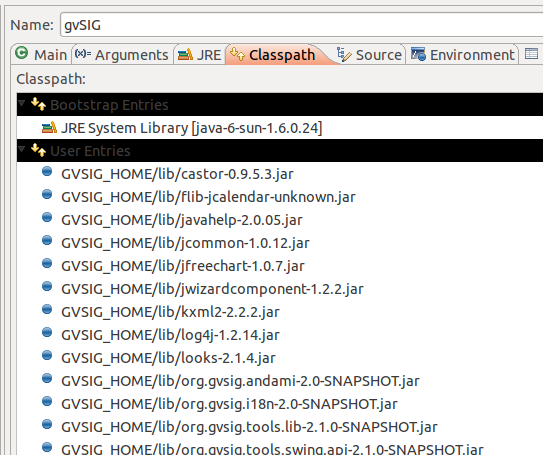
Initially, we created the launchers by adding in the classpath tab all the andami jar files and its dependencies:

Initial gvSIG launcher classpath configuration

Initial gvSIG launcher classpath configuration

It worked very well until we had to change or upgrade any of the Andami dependencies. Then all previously prepared launchers where broken and had to be updated by hand.

Looking for a solution, we found that a jar file is able to define the classpath of its dependencies, thanks to the Class-Path: entry in the MANIFEST.MF file. So if we were able to create that entry while generating the andami jar file, we could simplify the gvSIG launchers, making them independent of andami dependency changes. Something like this:

Simplifyied launcher classpath

Simplifyied launcher classpath

Luckily one of the changes performed in the gvSIG desktop 2.0 branch has been to change the build process from ant to maven, and the maven-jar-plugin has an option to fill the Class-path MANIFEST.MF entry automatically from the project dependencies.

So we only needed to add the following to the pom.xml file of the _fwAndami project:

    <build>
        <plugins>
           ...
           <plugin>
                <groupId>org.apache.maven.plugins</groupId>
                <artifactId>maven-jar-plugin</artifactId>
                <configuration>
                    <archive>
                        <manifest>
                            <addClasspath>true</addClasspath>
                            <mainClass>org.gvsig.andami.Launcher</mainClass>
                        </manifest>
                    </archive>
                </configuration>
            </plugin>
        </plugins>
    </build>

And that’s all. Once you perform a mvn install on the andami project and the andami jar file is generated, if you open it and look into the META-INF/MANIFEST.MF file, the contents will look something like:

Manifest-Version: 1.0
Archiver-Version: Plexus Archiver
Created-By: Apache Maven
Build-Jdk: 1.6.0_24
Main-Class: org.gvsig.andami.Launcher
Built-By: gvSIG Team
Class-Path: slf4j-api-1.5.5.jar slf4j-log4j12-1.5.5.jar log4j-1.2.14.j
 ar org.gvsig.tools.lib-3.0.0-SNAPSHOT.jar kxml2-2.2.2.jar xmlpull-1.1
 .3.1.jar org.gvsig.maven.base.tools-1.0.8-SNAPSHOT.jar org.gvsig.i18n
 -2.0.1-SNAPSHOT.jar org.gvsig.tools.swing.api-3.0.0-SNAPSHOT.jar org.
 gvsig.tools.swing.impl-3.0.0-SNAPSHOT.jar org.gvsig.tools.swing.spi-3
 .0.0-SNAPSHOT.jar org.gvsig.tools.swing.serv.field-3.0.0-SNAPSHOT.jar
  flib-jcalendar-unknown.jar org.gvsig.tools.swing.serv.jform-3.0.0-SN
 APSHOT.jar org.gvsig.tools.swing.serv.jlist-3.0.0-SNAPSHOT.jar org.gv
 sig.utils-2.0-SNAPSHOT.jar castor-0.9.5.3.jar org.gvsig.ui-2.0.1-SNAP
 SHOT.jar jcommon-1.0.12.jar jfreechart-1.0.7.jar jwizardcomponent-1.2
 .2.jar org.gvsig.installer.lib.api-1.0.1-SNAPSHOT.jar org.gvsig.insta
 ller.lib.impl-1.0.1-SNAPSHOT.jar org.gvsig.installer.lib.spi-1.0.1-SN
 APSHOT.jar org.gvsig.installer.prov.plugin-1.0.1-SNAPSHOT.jar ant-1.8
 .1.jar ant-launcher-1.8.1.jar org.gvsig.installer.swing.api-1.0.1-SNA
 PSHOT.jar org.gvsig.installer.swing.impl-1.0.1-SNAPSHOT.jar batik-gui
 -util-1.7.jar batik-util-1.7.jar batik-xml-1.7.jar javahelp-2.0.05.ja
 r looks-2.1.4.jar xercesImpl-2.5.0.jar

This also has the benefit of being able to launch gvSIG from command line very easily. Just go into your gvSIG folder and run the following command (albeit defining some environment variables would be needed also for the native libraries to work as expected):

java -jar lib/org.gvsig.andami-2-SNAPSHOT.jar gvSIG gvSIG/extensiones
Posted in development, english, gvSIG Desktop, gvSIG development | Tagged , , , | 1 Comment

gvSIG 1.11 at OSGeo Live

Tomorrow is the feature freeze dateline for the fifth release of the OSGeo Live project. As always we are at the last chance to update our scripts to add to the DVD our latest release of gvSIG. So thanks to the help of José Vicente Higón, from Software Colaborativo, I’ve updated the script. Thus, the next OSGeo Live DVD will ship with gvSIG 1.11.

There are also some changes. As gvSIG 1.11 comes with an integrated help (yes it’s on the, surprise!, help menu) I’ve removed downloading any documentation. With the overview, the integrated help and the nice quick start created by Simon, the OSGeo Live disc has enough information for any newcomer. The interface will start in English by default so no problem for new users struggling about how to change from Spanish to whatever.

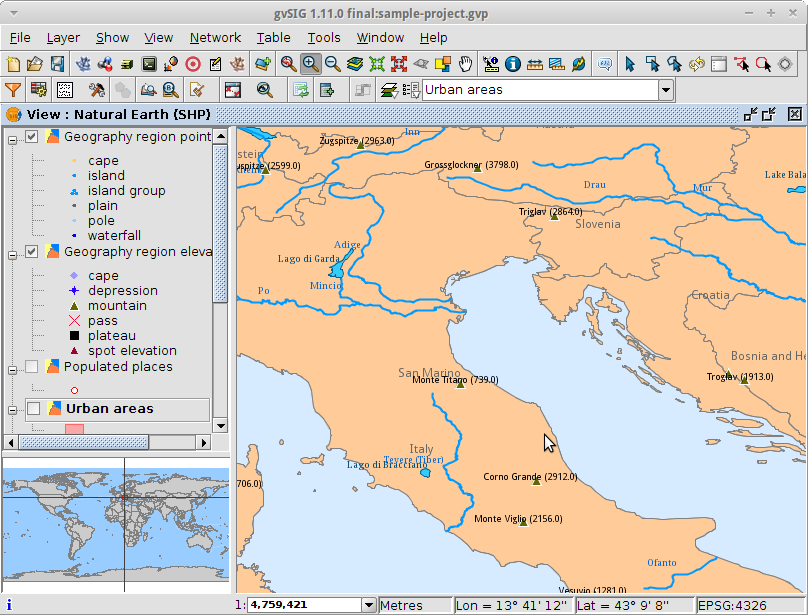
I’ve spent a couple of hours to create and configure a sample project using Natural Earth data present on the disc, showcasing a little of the gvSIG symbology and legend capabilities. I’ve also added a sample map with the typical suspects (grid, legend, titles, etc).  So when any new user opens gvSIG this project will automatically be opened with data ready to play. I’m not fully satisfied with the sample project, we can do a lot more with Natural Earth data to show more gvSIG capabilities but well, for this time I think is good enough.

Of course, as the disc will come with a lot of OGC services and other kinds of data, the user will be able to experiment and learn about a great stack of FOSS4G and open data!!

Posted in english, events, gvSIG Desktop | Tagged , , | 5 Comments

1as. Jornadas gvSIG Uruguay “La Información Geográfica al alcance de todos”

Los días 16 y 17 de junio de 2011, en el edificio de la Facultad de Arquitectura (UDELAR) en Montevideo, se realizaron las 1as. Jornadas gvSIG Uruguay, cuyo lema fue “La Información Geográfica al alcance de todos” (http://www.gvsig.org/web/community/events/jornadas-uruguay/2011). El primer día fue de ponencias y el segundo de talleres. Como miembro del Comité de Organización y de la recientemente creada Comunidad gvSIG Uruguay me siento plenamente satisfecho con los resultados: más de 300 inscriptos, cerca de 180 asistentes efectivos (entre argentinos, brasileros y mexicanos, además de uruguayos de todo el país y un representante español de la Asociación gvSIG), 12 ponencias (de las cuales 3 de Argentina y 1 de Brasil) que fueron evaluadas y aprobadas por un Comité Científico creado para la ocasión, una mesa de apertura con autoridades nacionales de jerarquía, una mesa final de debate sobre el tema “¿Por qué importa que gvSIG sea software libre?”, 2 talleres de usuarios con aforo completo dictados por profesionales universitarios locales, y 1 taller de desarrollo dictado por el responsable de Arquitectura y Desarrollo de la Asociación gvSIG venido especialmente para el evento.

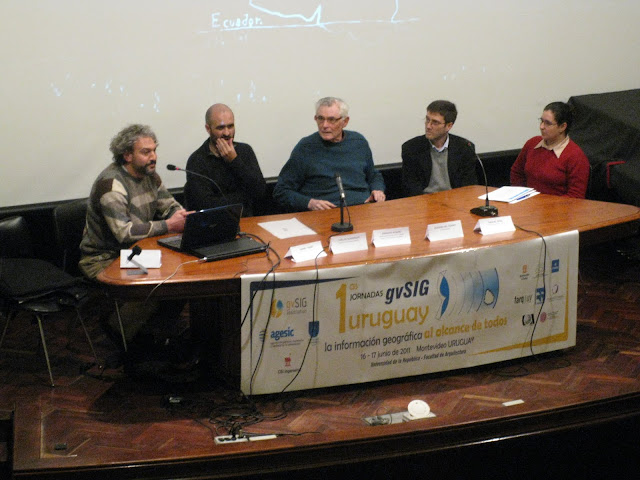
mesa de apertura; de izq. a der.: José Clastornik (Director AGESIC), Daniel Martínez (Senador de la República), Gustavo Scheps (Decano Fac. Arquitectura)

Mesa de apertura; de izq. a der.: José Clastornik (Director AGESIC), Daniel Martínez (Senador de la República), Gustavo Scheps (Decano Fac. Arquitectura)

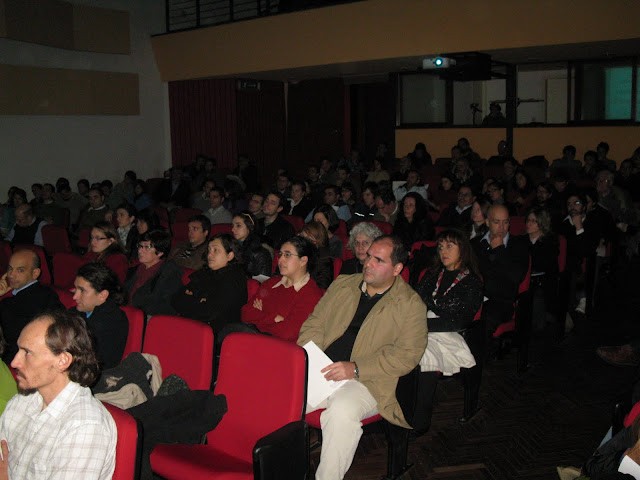
Asistentes

Asistentes

Hasta aquí, los números. Importantes, si. Pero más aún lo son los resultados cualitativos: lo que unos meses atrás aparecía sólo como un deseo hoy ya es una realidad concretada, un hito de destaque en el camino de los Sistemas de Información Geográfica (SIG/GIS) en general, y de gvSIG en particular, en Uruguay. Y esto fue posible gracias al esfuerzo mancomunado de un variado grupo de actores que brindaron su tiempo, su esfuerzo y sus capacidades de manera entusiasta, sincera e irrestricta. Quiero destacar la labor de mis compañeros de Comité (y la colaboración de sus instituciones de origen), la de los integrantes del Comité Científico, el apoyo de la Universidad de la República (en especial las Facultades de Arquitectura -anfitriona del evento-, de Ciencias y de Ingeniería), de AGESIC, de la empresa CSI, de la Comunidad de Software Libre de Uruguay, y de todos los que colaboraron con la difusión del evento (incluyo aquí en especial a la Sociedad de Arquitectos). Y muy especialmente a la Asociación gvSIG que apostó fuertemente por el éxito de estas Jornadas.

Mesa de clausura; de izq. a der.: Daniel Viñar (CSIC), Carlos Soderguit (Grupo Usuarios JAVA), Ernesto Agazzi (Senador de la República), Joaquín del Cerro (Asociación gvSIG), Raquel Sosa (Fac. Ingeniería)

Este esfuerzo compartido es prueba de que se cree en el proyecto gvSIG, que la Comunidad se consolida, que hay una muy buena disposición a compartir (información, conocimiento, experiencias) y que se avanza hacia un nuevo paradigma de colaboración y cooperación, que lentamente sustituya el modelo de competencia imperante.

Taller de desarrollo

Taller de desarrollo

Taller de usuarios (vespertino)

Taller de usuarios (vespertino)

Estas Jornadas sirvieron para presentar en sociedad a la recién constituida Comunidad gvSIG Uruguay (http://www.gvsig.org/web/community/comm_groups/comm_gvsig_uy/). Desde aquí invitamos a todo aquel que quiera, a sumarse a la iniciativa. Pueden hacerlo suscribiéndose a la lista de correo (http://www.freelists.org/list/gvsig_uruguay). Los animamos a plantear sus preguntas, dudas y comentarios a través de la misma. También les recordamos la existencia de la lista de correo de usuarios (general, internacional en castellano) muy activa en la que pueden plantearse consultas más técnicas referidas a los productos del proyecto gvSIG (http://listserv.gva.es/cgi-bin/mailman/listinfo/gvsig_usuarios).

Esperamos que estas 1as. Jornadas sean sólo el comienzo y que vengan muchas más.

Fotos en https://picasaweb.google.com/116451026023012881874/GvSIGuy#

Posted in community, events, gvSIG Association, opinion, spanish | 3 Comments

Call for Mac Community contributors

As you all know one of the main benefits of FOSS projects is the community participation. Community contributions make projects better and greater, covering areas that otherwise they couldn’t achive. One of these areas is multiple Operative System support.

Currently gvSIG officialy supports some GNU/Linux distributions and Windows but thanks to Rafael Gaitán and the ai2 Institute of the Universidad Politécnica de Valencia (the gvSIG 3D extension team) there is for a while a gvSIG non-oficial distribution for Mac OS X, increasing the supported platforms to this new one.

This is, with no doubt, a great contribution for the project, specially appreciated for OS X users, and we think it could be a good starting point to definitely boost the gvSIG Mac Community in order to have a gvSIG distribution for Mac from now on.

We think it would be interesting to promote the creation of a working group composed of Mac developers and users whose goal would be, first of all, define the minimum roles and tasks needed to carry out the maintenance of the distribution, and secondly, to carry out these tasks.

The working group would work autonomously and it would have the support of the gvSIG TSC Board and the gvSIG development and testing teams.

Those who are interested in actively participate in this working group, please, leave a comment or, if you prefer, send an e-mail to Manuel Madrid (mmadrid [at] gvsig [dot] com) introducing himself, indicating his profile (developer/user) and the tasks he thinks he can contribute on.

Posted in opinion | 5 Comments

Quarte Giornate Italiane di gvSIG

Pochi giorni fa ho avuto il piacere di partecipare alle Quarte Giornate Italiane di gvSIG, tenutesi questa volta a Udine. Vorrei iniziare questo post ringraziando l’impegno della comunità italiana e in particolare Alessandro Sgambati, che ha guidato l’organizzazione del convegno.

La comunità italiana è senza dubbio, dopo quella spagnola, la comunità gvSIG più radicata dell’Europa. Infatti, è già da diversi anni che esiste la mailing list in italiano e, come ho scoperto, sono sempre più le istituzioni e le regioni che utilizzano gvSIG: Sardegna, Milano, Trieste, Udine, Bolzano…

Ma non solo in Italia ci sono italiani usando gvSIG. Mi sono stupito di vedere i progetti che i membri della comunità italiana stano portando avanti in Africa e Medio Oriente con gvSIG. È stato una piacevole sorpresa il fatto che gvSIG venga usato dall’Unicef.

Un altro argomento importante è quello delle sempre più numerose aziende che pensano a gvSIG come parte rilevante del loro modello di negozio. Pochi mesi fa abbiamo annunciato che GISMAP era diventato il primo membro dell’Associazione gvSIG, e speriamo presto di incorporare nuove società per cui il software GIS libero sia parte della loro visione.

Colgo l’occasione per commentare che il convegno ci ha fatto incontrare personalmente Markus Neteler, leader del progetto GRASS, “padre” di tutti i progetti GIS liberi. E’ una soddisfazione avere la funzionalità di GRASS dentro gvSIG via il geoprocess manager di SEXTANTE.

In breve abbiamo trascorso dei giorni fantastici in un clima di collaborazione e di condivisione della conoscenza. Mi pare che si stia già parlando delle diverse città che si candidano per le Quinte Giornate Italiane di gvSIG…

Posted in community, events, spanish | 1 Comment